Fujiwhara Effect
Subject: Geography (UPSC Prelims)
Source: DTE
Context:
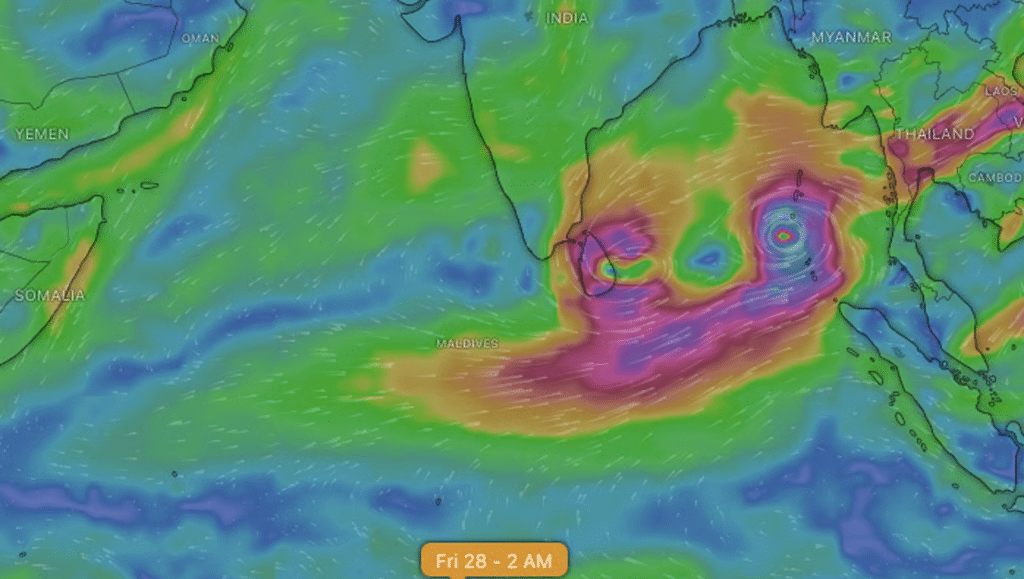
Two developing cyclonic systems over the Bay of Bengal may come close enough to interact with each other, leading to what is known as the Fujiwhara Effect.
What is the Fujiwhara Effect?
It is a rare weather phenomenon where two cyclones come close and begin to rotate around a common centre, instead of moving independently.
This happens because their wind circulations start interacting.
- First proposed by Sakuhei Fujiwhara (1921)
- Usually seen when two tropical cyclones move within ~1400 km of each other.
Conditions Needed
The Fujiwhara Effect occurs when:
- Two cyclones form close to each other (less than ~1400 km apart)
- Both rotate in the same direction
- Sea temperature is warm (above 26°C)
- Wind shear is low (cyclones remain structurally stable)
How Does It Happen? (Simple Steps)
- Two storms develop nearby
Their wind fields begin to overlap. - Circulation starts interacting
They slow down and curve towards each other. - Rotation around each other begins
Both storms move in a circular or spiral motion around a shared pivot point. - Possible outcomes:
- One cyclone orbits the other
- The stronger one absorbs the weaker
- Both may merge into a single stronger cyclone
- Or they repel and move away in different directions
Key Characteristics
- Movement becomes unpredictable
- One cyclone can steal moisture and energy from the other
- The system may merge into a more powerful cyclone
- Cyclones may stall, causing extended rainfall
Why It Matters
| Impact | Result |
|---|---|
| Forecast difficulty | Landfall and intensity become hard to predict |
| Longer rainfall duration | Higher risk of floods & crop damage |
| Chance of stronger cyclone | If merger or energy transfer occurs |
| Higher coastal risk | Storm surge, strong winds, river flooding |
This effect is rare but dangerous, because it can dramatically change cyclone paths, strength, and rainfall patterns in a very short time.