🗳️ Electoral Justice at the Crossroads: Supreme Court Intervention and the Strategic Reform of the Election Commission of India
Syllabus: UPSC GS II (Polity & governance), GS IV – (Ethics)
I. Introduction: Political Justice and the Democratic Promise
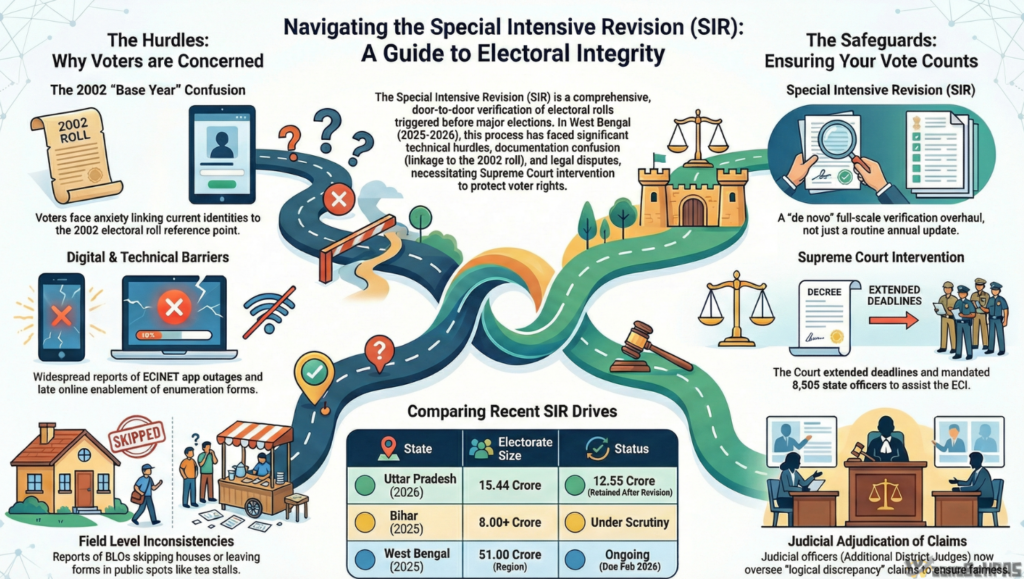
The Preamble to the Constitution of India guarantees Political Justice — ensuring that every citizen can participate equally in the democratic process. In a country with over 950 million voters, including massive electorates like Uttar Pradesh (15+ crore) and Bihar (8+ crore), the credibility of elections rests not merely on logistics but on institutional integrity.
The recent intervention of the Supreme Court of India in the Special Intensive Revision (SIR) of electoral rolls in West Bengal (2026) marks a defining moment. The Court flagged a “trust deficit” between the Election Commission of India (ECI) and the State government and ordered deployment of serving and retired district judges to oversee claims and objections in voter list revisions.
This episode is not an isolated administrative dispute; it is a “So What?” moment for democratic legitimacy.
II. The West Bengal SIR Controversy: Constitutional Tensions in Action
📌 Background
Under Article 324 of the Constitution and the Representation of the People Act, 1951, the ECI is empowered to supervise electoral roll revisions.
During the 2025–26 SIR exercise in West Bengal:
- Thousands of voters were placed in the “Logical Discrepancy (LD)” category.
- Disputes arose over:
- Appointment of appropriate rank officers (Group A vs. Group B).
- Overriding of quasi-judicial functions of Electoral Registration Officers (EROs).
- Administrative cooperation between State authorities and ECI.
- Allegations of obstruction and procedural friction deepened mistrust.
⚖ Supreme Court’s Intervention
Invoking constitutional authority (including Article 142 for “complete justice”), the Court:
✔ Directed the Chief Justice of Calcutta High Court to appoint judicial officers.
✔ Ordered logistical and security support from District Collectors and SPs.
✔ Ensured deadlines for roll publication were preserved.
✔ Mandated coordination among constitutional functionaries.
🔎 Why Is This Important?
This reflects:
- Judicial oversight to preserve free & fair elections
- Reinforcement of the Basic Structure Doctrine
- Restoration of institutional credibility
III. Ethical Architecture of Electoral Governance
Elections are not merely procedural exercises — they are moral undertakings.
✨ Foundational Values in Electoral Administration
| Value | Electoral Significance |
|---|---|
| Integrity | Resisting political pressure during roll verification |
| Objectivity | Evidence-based decisions on inclusion/exclusion |
| Impartiality | Neutral treatment of all political actors |
| Dedication to Public Service | Protecting voter rights amid political contest |
| Empathy & Compassion | Safeguarding vulnerable communities |
⚠ Ethical Concerns in SIR
- Administrative overload on Booth Level Officers (BLOs)
- Reported stress and burnout
- Documentation barriers affecting:
- Refugees
- Matua community
- Enclave residents
🔹 Ethics Paper IV Link:
This case demonstrates how institutional ethics must extend to both voters and administrators.
IV. Structural Reform: Reimagining the ECI Appointment Process
The Trust Deficit Problem
Perception of executive dominance in appointments risks weakening neutrality.
Proposed Reform: Collegium-Style Appointment Mechanism
A Three-Member Collegium:
- Prime Minister
- Leader of Opposition
- Chief Justice of India
Why This Matters:
✔ Enhances bipartisan legitimacy
✔ Reduces perception of “executive capture”
✔ Strengthens quasi-judicial authority of EROs
✔ Prevents recurrence of SIR-type institutional friction
🔹 GS II Link: Constitutional bodies — structure, appointment, independence.
V. Bridging the Enforcement Gap: From Soft Power to Statutory Strength
1️⃣ Codification of Model Code of Conduct (MCC)
Currently, MCC lacks statutory backing.
Reform Suggestion:
Convert MCC into enforceable law with penalties.
2️⃣ Disqualification Powers
Empower ECI to disqualify candidates for:
- Repeated violations
- Communal speech (Section 123, RPA 1951)
- Electoral malpractice
3️⃣ Campaign Finance Transparency
- Phase out opaque funding instruments.
- Mandatory disclosure above threshold limits.
- Prevent corporate capture of elections.
🔹 GS II & GS III Link: Electoral reforms + Political funding transparency.
VI. Technology, Migration & Administrative Challenges
⚙ Digital Disruptions
- ECINET portal outages
- OTP failures
- Technical glitches affecting verification
🧾 Documentation Barriers
Replace rigid base-year linkage systems with:
✔ Presumption of Validity principle
✔ Acceptance of diverse identity documents
✔ Nationwide Remote Voting mechanisms
⚖ Role of Judiciary
The Judiciary remains the guardian of the Basic Structure, ensuring:
- Swift dispute resolution
- Prevention of executive overreach
- Timely correction of electoral irregularities
🔹 Key Insight:
Judicial intervention should be corrective — not routine. Sustainable reform must reduce dependence on courts.
VII. Governance Lessons from the SIR Episode
🔥 Challenges vs Reform Solutions
| Challenge | Reform Solution |
|---|---|
| Administrative non-cooperation | Collegium-appointed neutral ECI |
| Officer rank disputes | Clear statutory service rules |
| Disenfranchisement fears | Presumption of Validity doctrine |
| MCC violations | Statutory codification |
| Judicial delays | Fast-track election courts |
| BLO stress | Resource augmentation & welfare safeguards |
VIII. The Gandhian Principle: Unity of Means and Ends
Democratic legitimacy rests on ethical processes.
If elections produce leaders through flawed means, legitimacy erodes.
✔ The election process must be as ethical as governance itself.
✔ Protection of voter dignity and administrative safety is non-negotiable.
✔ Institutional trust must replace institutional suspicion.
🔎 UPSC Examination Relevance
📚 GS Paper II
- Election Commission of India
- Article 324
- Free & fair elections (Basic Structure)
- Separation of powers
- Judicial activism vs judicial overreach
📚 GS Paper IV (Ethics)
- Integrity in public administration
- Institutional trust
- Non-partisanship
- Ethical leadership
- Empathy in governance
📚 Essay Topics
- “Electoral Reforms and Democratic Legitimacy”
- “Institutional Integrity as the Backbone of Democracy”
🏁 Conclusion: From Trust Deficit to Democratic Renewal
The Supreme Court’s intervention in West Bengal’s SIR is both a symptom and a signal:
- A symptom of institutional strain.
- A signal for structural reform.
India’s electoral democracy does not merely require efficient management — it requires constitutional morality, ethical leadership, and institutional redesign.
The promise of Political Justice must move:
From principle to practice — every election, every vote, every time.