Dry Winter in Northwest India (2025–26)
Meteorological Mechanics, Socio-Economic Risks and Policy Roadmap(Dry Winter)
Syllabus: UPSC GS-I&III – (Environment & Disaster Climate)
Introduction
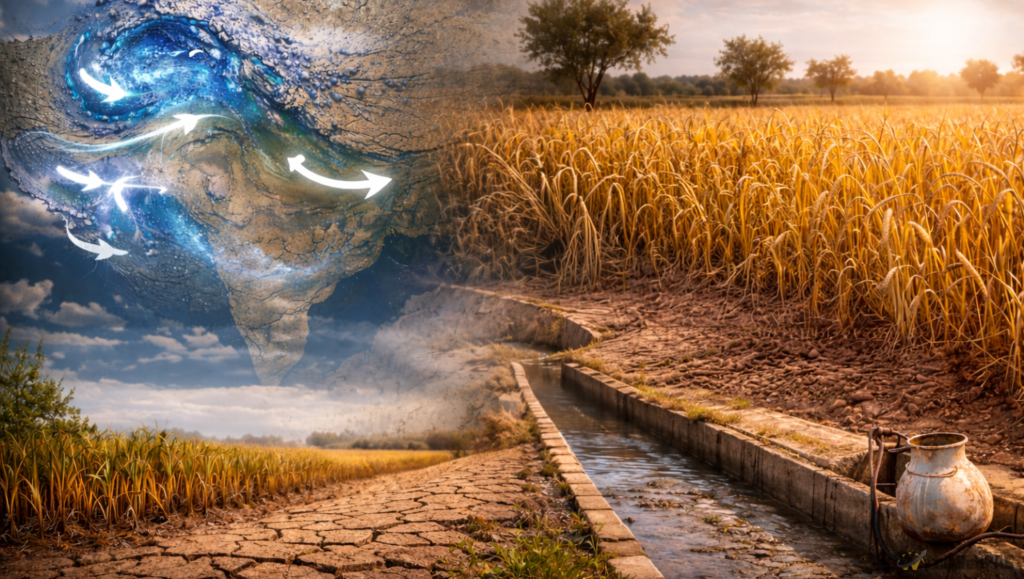
The winter of 2025–26 has emerged as one of the driest in recent decades for Northwest India—Punjab, Haryana, Himachal Pradesh, Uttarakhand, J&K, Rajasthan and western UP. The region, normally dependent on Western Disturbances (WDs) for winter rain and snow, has recorded an 80% precipitation deficit during the crucial January window.
This is not merely a seasonal anomaly but a systemic risk to India’s food security, water resources and Himalayan ecology. The failure of winter moisture disrupts:
- Rabi crops (wheat, mustard, gram)
- Snowpack that feeds rivers and glaciers
- Horticulture in the hills (apple, almonds)
- Rural livelihoods of marginal farmers.
1. Executive Overview: Why This Winter Matters
The “Chillai Kalan” Factor
- Period: 21 December – 29 January
- Known as the coldest phase in Kashmir–Himalaya
- Provides heavy snowfall → natural water storage
2025–26 Reality
- Virtually snowless Chillai Kalan
- Streams and springs running below normal
- January—usually the wettest winter month—remained dry.
UPSC Insight: Himalayas act as India’s “Water Tower.”
Loss of snowpack = summer water insecurity + glacier instability.
Infographic
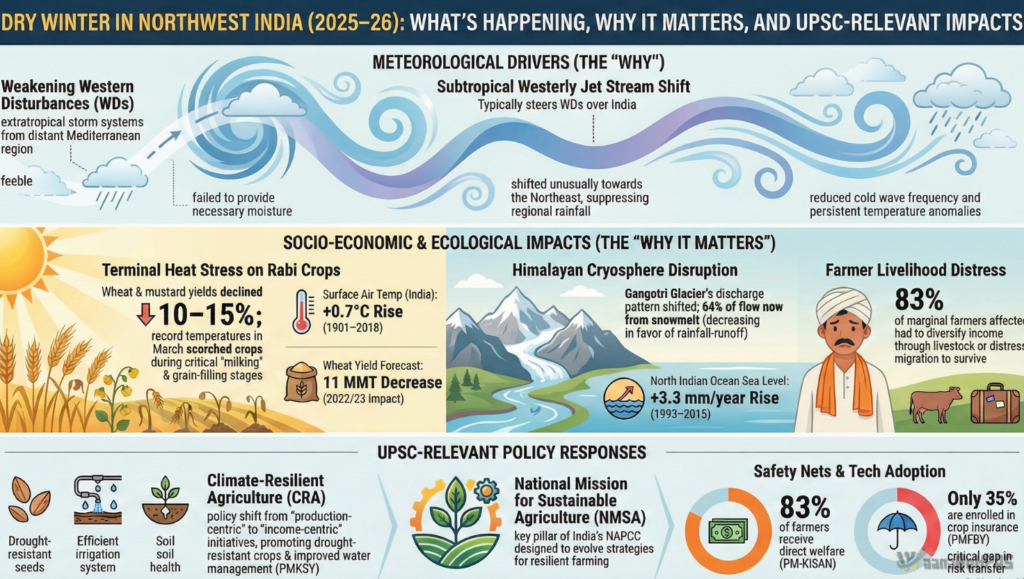
2. Meteorological Mechanics – The Triple Failure
Northwest winter climate depends on an atmospheric “supply chain.” In 2025–26, three drivers failed together:
A) Absence of Active Western Disturbances
- Normal winter: 5–7 WDs bring rain/snow
- This season: systems were weak, fast-moving, moisture-starved
- Result: no cloud cover → higher day temperatures, colder nights.
B) El Niño Influence
- Warm central Pacific altered global circulation
- Suppressed moisture transport toward India
- Reduced frequency of cold waves with precipitation.
C) Jet Stream Misalignment
- Subtropical westerly jet positioned unfavourably
- Created anticyclonic dry cold instead of precipitation.
Fog without Rain – A Paradox
| Condition | Result this Winter |
|---|---|
| Weak winds | No atmospheric mixing |
| Temperature inversion | Trapped surface moisture |
| Cloudless nights | Rapid cooling → dense fog |
Thus: visibility crisis but zero rainfall.
3. Ecological & Hydrological Crisis in Himalayas
A) Snowpack Deficit
- Snow is a slow-release reservoir
- Absence means:
- poor groundwater recharge
- reduced spring flows
- stress on rivers in summer.
B) Phenological Disruptions
- Warm days triggered early blooming in Ladakh & Kashmir
- Without snow insulation → flowers face:
- late frost
- “dry cold” shocks
- fruit-set failure.
C) Disaster Risks
- Faster glacier melt
- Formation of pro-glacial lakes
- Higher probability of GLOF events
- Increased winter forest fires due to dry litter.
4. Agriculture Under Stress – Wheat & Mustard
Thermal Thresholds for Wheat
| Stage | Danger Temperature |
|---|---|
| Flowering | 31°C |
| Grain Filling | 35°C |
Yield Loss Proxy (Global Studies)
- +1°C at flowering → ~518 kg/ha loss
- +1°C at grain filling → ~1140 kg/ha loss
Mechanism:
Heat → shortened grain filling → shrivelled grains → low weight.
Mustard Risks
- Highly sensitive to radiative frost
- No WD clouds → greater night cooling.
Field Mitigation
- Light irrigation (raises heat capacity)
- Smoke insulation
- Plastic mulching → soil temp +10°C.
5. Water Resources – Beyond One Season
- Reduced snow persistence weakens:
- aquifers
- hill springs
- base flow to Indus–Ganga tributaries.
- Though reservoirs from good monsoon may buffer 2026 rabi, repeated dry winters = structural water crisis.
6. Socio-Economic Dimension: The Marginal Farmer
Who is Most Affected?
- 68.5% of Indian farmers cultivate <1 ha
- Average holding: 0.38 ha
Income Shock
| Crop | Median Loss |
|---|---|
| Paddy | ₹8,400 |
| Wheat | ₹9,200 |
- For 0.01–0.40 ha farmers → 78% of annual crop income wiped out
- 0.40–1.00 ha → ~28% loss.
Coping Strategies
- 72% depend more on livestock
- 1 in 3 resort to distress migration
- 47% seek MGNREGS work.
7. Policy Framework – What Exists, What Fails
| Scheme | Role | Gap |
|---|---|---|
| PM-KISAN | Income support | 13% exclusion |
| PMFBY | Crop insurance | Only 35% enrolled |
| Soil Health Card | Moisture/nutrient mgmt | 17% usage |
| Custom Hiring Centres | Mechanisation | 66% lack access |
8. Strategic Roadmap (UPSC-Ready)
A) Shift in Policy Metric
- From “tonnes per hectare” →
- to “kg of grain per cubic metre of water.”
B) Universal Risk Protection
- Saturate PMFBY for marginal farmers
- Index-based insurance for frost & heat waves.
C) Digital Public Infrastructure
- Agri-Stack + IMD Agromet
- plot-level advisories for irrigation & sowing.
D) Himalayan Water Security
- Spring-shed revival
- snow & glacier monitoring
- GLOF early warning.
E) Bazaar Innovations
- Agritech (SatSure, DeHaat, IBISA)
- village micro-cold storage
- affordable CHCs.
UPSC VALUE ADD
Syllabus Links
GS-1:
- Western Disturbances, Himalayan climatology
GS-3:
- Agriculture & climate change
- Water security, disasters, environment
Essay:
- Food–Water–Climate Nexus
- Himalayan ecology & development.
Probable Mains Questions
- Explain the role of Western Disturbances in Northwest India’s rabi economy. Assess impacts of the 2025–26 dry winter on food and water security.
- “Himalayan snowpack is India’s strategic water reserve.” Discuss consequences of its decline and policy responses.
- Evaluate India’s farm safety nets in protecting marginal farmers from climate variability.
10 Prelims One-Liners
- WDs originate in Mediterranean region.
- Chillai Kalan: 21 Dec–29 Jan.
- Snowpack ensures gradual summer discharge.
- Wheat heat threshold: 31°C flowering.
- Mustard vulnerable to radiative frost.
- El Niño reduces winter moisture.
- Fog can occur without rainfall under inversion.
- GLOF risk rises with warm winters.
- PMFBY enrollment only ~35%.
- Average marginal holding: 0.38 ha.
Conclusion
The dry winter of 2025–26 signals a paradigm shift:
From production-centric agriculture → resilience-centric food systems.
India must integrate meteorology + technology + social protection to shield the marginal farmer from the volatile physics of a warming planet.