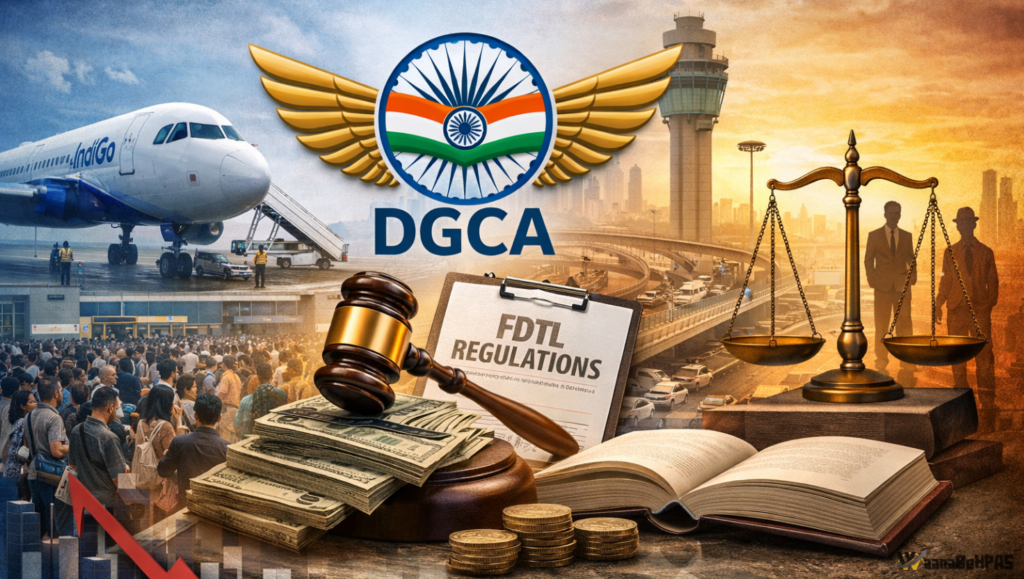
DGCA Fines IndiGo: A Case Study in Systemic Failure, Consumer Rights and Regulatory Governance
Syllabus: UPSC GS II & III (Polity & Governance, Economy)
1. Introduction: Why This Matters
The Directorate General of Civil Aviation’s (DGCA) unprecedented penalty on IndiGo following the December 2025 operational meltdown is more than an isolated corporate failure. It is a defining case study on:
- the limits of low-cost aviation models,
- the tension between commercial optimisation and safety resilience,
- the evolving strength of India’s sectoral regulators, and
- the real meaning of consumer rights in essential network industries.
With IndiGo commanding nearly 65% of India’s domestic market, any disruption in its operations becomes a national mobility crisis. The episode therefore offers invaluable lessons for UPSC themes such as regulatory mechanisms, corporate governance, consumer protection, infrastructure management, and public policy design.
2. Anatomy of the December 2025 Meltdown
Scale of Disruption
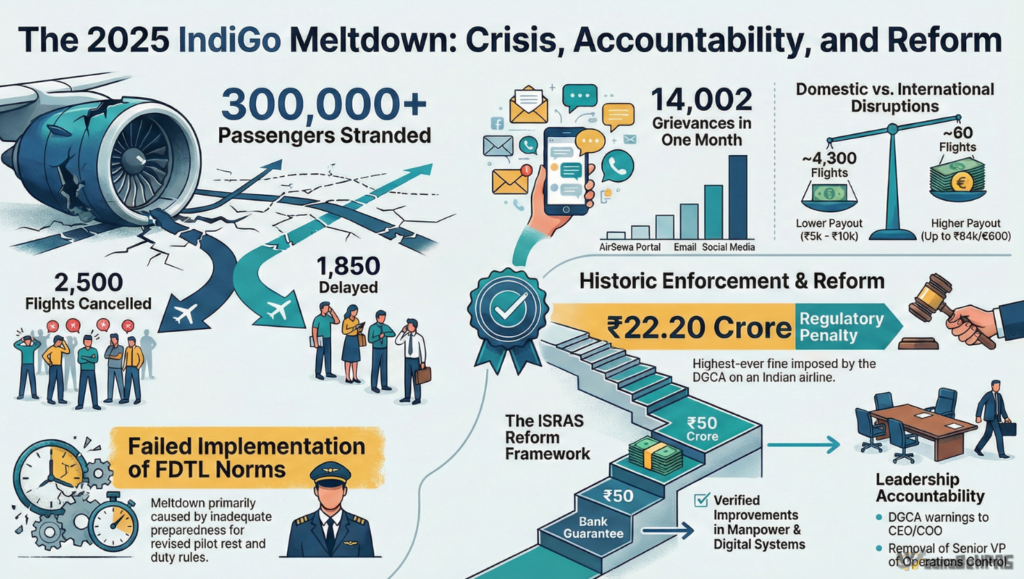
During the first week of December 2025, IndiGo’s network collapsed as the airline transitioned into the Winter Schedule alongside new Flight Duty Time Limitation (FDTL) norms. The peak occurred on 5 December 2025:
- 1,600+ flights cancelled out of ~2,300 scheduled
- Nearly 70% of operations grounded in a single day
- Over 3 lakh passengers stranded nationwide
Cumulative impact (1–9 December):
| Indicator | Numbers |
|---|---|
| Total cancellations | 2,507 flights |
| Total delays | 1,850 flights |
| Passengers affected | 3,00,000+ |
This was not a routine disruption but a systemic network failure where roster breakdown, crew shortages, and poor contingency planning cascaded across the country.
3. Root Causes: The “Utilisation vs Resilience” Paradox
A. Over-Optimisation Trap
Low-cost carriers survive on extreme asset utilisation—more flight hours per aircraft, tighter turnarounds, leaner crews. IndiGo’s model had minimal buffers. When new FDTL norms reduced permissible duty hours, the system lacked elasticity and collapsed non-linearly.
B. FDTL Preparedness Failure
- Management underestimated manpower needs under revised fatigue rules.
- Rosters designed for old norms became illegal overnight.
- No phased transition plan for Winter Schedule 2025.
C. Digital & Planning Deficits
- Crew-rostering and Maintenance & Engineering (M&E) software were not updated to validate new FDTL limits.
- Heavy dependence on tail-swaps and dead-heading created fragile schedules.
D. Compensation Economics Bias
International flights—where liabilities under EU EC-261 can reach ₹64,000 per passenger—were protected, while domestic routes with weaker compensation were sacrificed. This revealed how commercial calculus can override consumer equity.
4. DGCA’s Regulatory Reckoning
Financial Enforcement – ₹22.20 Crore
DGCA imposed India’s largest aviation penalty, structured to mirror daily profits and ensure deterrence:
| CAR Provision | Violation | Penalty |
|---|---|---|
| CAR 7/J/III | FDTL non-implementation & weak buffers | ₹30 lakh |
| CAR 8/O/VII | Operational responsibility failure | ₹30 lakh |
| CAR 3/C/II | Accountable management failure | ₹30 lakh |
| Continuing non-compliance (68 days) | Daily penalty | ₹20.40 crore |
| Total | ₹22.20 crore |
Personal Accountability
- CEO: Formal caution for inadequate crisis oversight
- COO: Warning for poor assessment of FDTL impact
- SVP Operations Control: Removed from accountable roles
ISRAS – Systemic Reform Assurance Scheme
A ₹50-crore bank guarantee tied to verified reforms:
- Leadership & Governance – ₹10 Cr
- Manpower & Fatigue Management – ₹15 Cr
- Digital Systems Upgrade – ₹15 Cr
- Board Oversight – ₹10 Cr
This reflects responsive regulation—moving from punishment to structural correction.
5. Consumer Rights: From Paper to Practice
Passenger Charter of Rights
India’s charter mandates:
- Refund/alternative travel for cancellations
- Assistance during long delays
- Grievance redress via AirSewa
Reality During Crisis
- Over 14,000 grievances on AirSewa
- MoCA created a 24×7 Passenger Assistance Control Room
- IndiGo compelled to issue ₹10,000 “Gesture of Care” vouchers for Dec 3–5 travellers
The episode showed that in India, enforcement remains complaint-driven, placing the burden on citizens rather than the airline.
6. DGCA in Exam Point of View
What is DGCA?
- India’s statutory aviation safety regulator under the Ministry of Civil Aviation
- Works under Aircraft Rules framework and issues Civil Aviation Requirements (CARs)
Core Functions
- Safety oversight & surveillance
- Licensing of crew and engineers
- Airworthiness standards
- Consumer grievance supervision
- Enforcement actions & audits
Legal Evolution
- Bharatiya Vayuyan Adhiniyam (BVA), 2024 replaced the 1934 Act
- Aligns India with ICAO standards
- Yet DGCA faces ~50% manpower shortage, limiting inspections
Proposed Reform: Civil Aviation Authority (CAA)
- FAA-style autonomous body
- Self-financing, independent recruitment
- Technical depth insulated from ministerial constraints
7. Governance Lessons for UPSC
A. Regulation in Network Industries
- Aviation disruptions have multiplier effects on tourism, health, business
- Sectoral regulators must ensure buffers, not just efficiency
B. Corporate Governance
- “Accountable Manager” principle essential in safety sectors
- Profit cannot override fatigue and safety science
C. Consumer Protection
- Need for automatic compensation, not complaint-based relief
- Strengthen AirSewa into quasi-adjudicatory platform
D. State Capacity
- Laws alone insufficient without inspectors, data systems, audits
8. Strategic Checklist for Aviation Leaders
- Digital readiness audits 90 days before schedule changes
- Non-negotiable roster buffers
- Independent Fatigue Risk Management Systems
- Real-time passenger assistance cells
- Board-level safety dashboards
9. Model UPSC Questions
Prelims
- DGCA functions under which ministry?
- FDTL norms relate to which aspect of aviation?
- AirSewa is administered by?
Mains (GS-II / GS-III)
- “Over-optimisation in essential services converts efficiency into fragility.” Discuss with reference to the IndiGo crisis.
- Evaluate DGCA’s enforcement toolkit in protecting consumer rights and aviation safety.
10. Conclusion
The IndiGo episode marks a coming of age for Indian aviation regulation. It demonstrates that:
- markets need guardrails,
- consumer rights must be enforceable, and
- resilience is as important as growth.
For a country aspiring to 400 airports by 2047, the central message is clear: connectivity without compliance is vulnerability.