Bangladesh’s Political Transition & the Future of India–Bangladesh Relations
From the “Golden Era” to a Strategic Reset
The political transformation in Bangladesh since August 2024 marks one of the most consequential geopolitical shifts in South Asia in recent decades. The collapse of the Awami League government ended a 15-year period of deep strategic alignment with India — often termed the “Shonali Adhyay” (Golden Era).
As Bangladesh moves through interim governance toward the February 2026 general elections, India–Bangladesh relations face a structural recalibration. What was once a regime-centric partnership now confronts a legitimacy deficit, strategic distrust, and geopolitical reorientation.
For UPSC aspirants, this issue is crucial for:
- GS-II: India and its neighbourhood, regional groupings, diplomacy
- GS-III: Internal security, border management, economic diplomacy
- Essay: Neighbourhood First Policy, Strategic Autonomy, Regional Stability
1️⃣ Historical Continuum: Foundations & Fault Lines
1.1 Liberation & Early Cooperation (1971–1975)
- India’s decisive role in the 1971 Liberation War created the moral and strategic foundation of bilateral ties.
- 1972 Treaty of Peace & Friendship institutionalized cooperation.
- 1974 Land Boundary negotiations began addressing enclave disputes.
This phase established India as Bangladesh’s principal strategic partner.
1.2 Counterbalancing Phase (1975–2008)
Following the assassination of Sheikh Mujibur Rahman:
- Military regimes under Ziaur Rahman and Ershad pursued balancing diplomacy.
- Increased engagement with Pakistan and China.
- Anti-India rhetoric became a domestic political tool.
This phase illustrates how domestic legitimacy politics influences foreign policy orientation — a recurring UPSC theme.
2️⃣ The “Golden Era” (2009–2024): Strategic Alignment & Its Limits
The return of Sheikh Hasina in 2009 ushered in unprecedented cooperation.
Key Strategic Gains
| Sector | Achievement |
|---|---|
| Security | Crackdown on Northeast insurgents (e.g., ULFA) |
| Border | 2015 Land Boundary Agreement (LBA) |
| Maritime | UN tribunal maritime boundary settlement |
| Economy | $8 billion Lines of Credit |
| Energy | 2,300 MW power imports by 2023 |
| Connectivity | Transit & transshipment rights |
Strategic Myopia
However, India’s unidirectional support for Hasina through controversial elections (2014, 2018, 2024) created:
- Perception of Indian backing for authoritarian consolidation
- Alienation of opposition forces (BNP, civil society)
- Structural path-dependency on a single political actor
This over-alignment resulted in a regime-centric foreign policy rather than institutionalized engagement.
3️⃣ The August 2024 Uprising & Interim Governance
The mass protests of July–August 2024 led to:
- Collapse of Awami League authority
- Emergence of a Muhammad Yunus-led interim administration
- Reported large-scale casualties during the crackdown
This was a strategic shock for India.
3.1 Diplomatic Recalibration
The interim leadership adopted a sovereignty-first posture:
- Framing Bangladesh as a maritime gateway for India’s Northeast
- Recasting transit access as strategic leverage rather than goodwill
This marks a shift from a junior-partner dynamic to assertive bargaining.
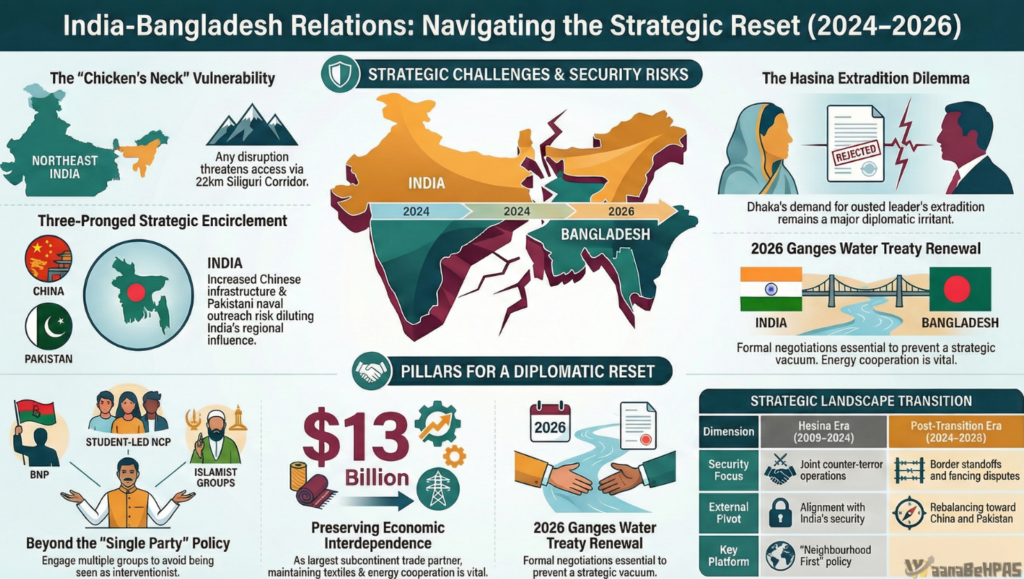
4️⃣ Key Friction Points: The Emerging Security Dilemma
The bilateral relationship has entered what can be described as a security dilemma phase, where defensive actions by one side are perceived as offensive by the other.
4.1 Border Management & Zero Line Conflict
- Disputes over fencing within 150 yards of the border
- Persistent allegations of border killings by BSF
- Heightened nationalist mobilization in Bangladesh
Border incidents now carry symbolic sovereignty value.
4.2 Water Diplomacy
Ganges Treaty
- Expires in December 2026
- Dhaka fears coercive water leverage
Teesta Agreement
- Long-pending due to Indian domestic federal constraints
- Bangladesh inviting Chinese participation in Teesta projects
Water-sharing has transformed into a strategic trust test.
5️⃣ Economic Interdependence Under Stress
5.1 Trade & Power Disputes
- Energy payment disputes with Indian firms
- Tit-for-tat restrictions on textiles and jute
5.2 Transit Leverage
Bangladesh controls critical access routes to India’s Northeast.
Rising transit fees indicate weaponization of geography.
5.3 Migration & “Push-In” Crisis
Indian domestic policies (NRC, CAA) are viewed in Bangladesh as demographic pressure tools.
Alleged “push-in” practices intensify mistrust.
6️⃣ Geopolitical Reorientation: The China–Pakistan Factor
Bangladesh’s interim leadership is diversifying partnerships.
6.1 Pakistan Rapprochement
- Renewed diplomatic and military contacts
- Potential revival of Northeast insurgent linkages (risk factor for India)
6.2 China Pivot
- Infrastructure investment in Mongla port
- Teesta management involvement
- Strategic proximity to the Siliguri Corridor (“Chicken’s Neck”)
A China-aligned Bangladesh could shift the strategic geometry of Eastern India.
6.3 SAARC vs BIMSTEC Contestation
Emergence of trilateral initiatives (China–Pakistan–Bangladesh) challenges India’s preferred regional frameworks.
7️⃣ Constitutional Reform & 2026 Election Reset
The July Charter referendum (70% approval) outlines reform trajectory:
Proposed Reforms:
- Two-term limit for Prime Minister
- Bicameral legislature
- Strengthening Election Commission
- Relaxing anti-defection provisions
The February 2026 elections may usher in:
- BNP-led moderate realignment
- Rise of Islamist right (Jamaat-e-Islami, NCP)
- Increased political fragmentation
India must prepare for multi-actor diplomacy.
8️⃣ Strategic Roadmap for India
India must transition from regime-centric diplomacy to spectrum engagement.
8.1 Immediate Goodwill Steps
- Restore medical and student visas
- Ease trade restrictions
- De-escalate media rhetoric
8.2 Institutionalize Engagement
- Track II diplomacy (academics, think tanks)
- Engage BNP and moderate Islamist factions pragmatically
- Avoid perception of interference
8.3 Border Confidence-Building
- Joint review of border firing protocols
- Transparent investigations into incidents
- Cooperative fencing solutions
8.4 Water & Connectivity Reset
- Fast-track Teesta negotiations
- Begin early talks for post-2026 Ganges treaty
- Expand BBIN connectivity projects
9️⃣ Analytical Framework for UPSC
Conceptual Themes:
- Small state agency in asymmetric relationships
- Regime security vs state interest
- Strategic autonomy in South Asia
- Security dilemma theory in bilateral relations
- Geoeconomic statecraft
1️⃣0️⃣ Conclusion: From “Golden Era” to Managed Realism
The India–Bangladesh relationship has transitioned from a personalized alignment to a structural recalibration.
The future depends on whether India can:
✔ Move beyond historical entitlement
✔ Institutionalize people-centric engagement
✔ Balance firmness with sensitivity
✔ Prevent strategic encirclement without coercion
Regional stability in the Indo-Pacific now hinges on a successful reset. Bangladesh must remain a partner in stability — not a theatre of geopolitical contestation.
📝 UPSC Answer Writing Summary (100-word essence)
The political transition in Bangladesh marks a shift from regime-based cooperation to structural recalibration in India–Bangladesh ties. Post-2024 upheaval, friction over borders, water, trade and migration has intensified, while Dhaka diversifies toward China and Pakistan. India must adopt non-partisan, institution-based engagement and confidence-building diplomacy to prevent a security dilemma and sustain neighbourhood stability.