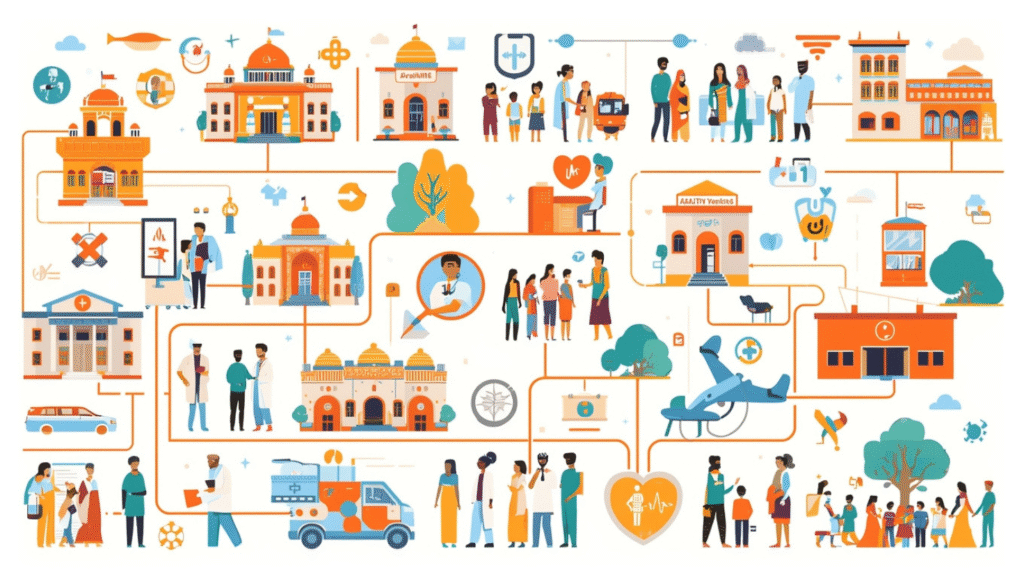
Ayushman Bharat – Key Features, Components, Eligibility & Achievements
Syllabus: Govt. Schemes (UPSC Prelims, GS II)
Introduction
Ayushman Bharat, launched in 20181, is India’s flagship health initiative aimed at achieving Universal Health Coverage (UHC). It implements the recommendations of the National Health Policy, 2017, and aligns with the UN Sustainable Development Goals (SDGs).
The scheme has two key components:
- Ayushman Arogya Mandirs (AAM) – strengthening primary healthcare
- Pradhan Mantri Jan Arogya Yojana (PM-JAY) – providing financial protection for secondary and tertiary care
1. Ayushman Arogya Mandirs (AAM)
Ayushman Arogya Mandirs (formerly Health and Wellness Centres) deliver Comprehensive Primary Health Care (CPHC) by upgrading Sub-Health Centres and Primary Health Centres.
Services Offered
- Preventive and promotive healthcare
- Curative and rehabilitative services
- Screening for NCDs
- Maternal and child health services
- Mental health care
- Teleconsultations (via e-Sanjeevani)
These centres act as the first point of contact ensuring continuum of care, supported by diagnostics, medicines, and referral pathways.
2. Pradhan Mantri Jan Arogya Yojana (PM-JAY)
PM-JAY is the world’s largest government-funded health assurance scheme, offering:
- ₹5 lakh per family per year for secondary and tertiary hospitalization
- No cap on family size, age, or gender
- Pre-existing conditions covered from Day 1
Coverage & Services
- Covers 1,949 medical procedures across 27 specialties
- Includes:
- Pre-hospitalisation evaluation
- ICU and non-ICU services
- Medicines and consumables
- Diagnostics and lab tests
- Implants
- Food and accommodation
- 15 days post-discharge care
- Cashless and paperless treatment via Direct Benefit Transfer
Continuum-of-Care Support
- Tele-health and referrals
- Expanded diagnostics
- Medicines at AAMs
- Provider payment reforms
- Strengthened human resources and multi-skilling
- Partnerships for knowledge and implementation
- Community mobilisation and health promotion
Eligibility Under PM-JAY
Eligibility is based on SECC (2011) deprivation and occupational criteria.
Rural Eligibility
Covers households meeting at least one of the SECC deprivation indicators such as:
- Landless labourers
- Destitute families
- Manual scavengers
- Scheduled Caste households
- Primitive tribal groups
- Bonded labourers
Urban Eligibility
Covers 11 occupational categories such as:
- Ragpickers
- Domestic workers
- Street vendors
- Cobblers
- Hawkers
- Sanitation workers, etc.
Exclusions under PM-JAY
Not eligible if the person is:
Financial/Property-Based
- Owner of a Kisan Credit Card with a limit ≥ ₹50,000
- Owner of ≥ 5 acres of agricultural land
- Possessing refrigerator, landline, or pucca house
- Monthly income above ₹10,000
Employment-Based
- Government employees (Central/State) or pensioners (₹10,000+)
- Workers in government-managed non-agricultural enterprises
Vehicle/Equipment Ownership
- Owners of 2/3/4 wheelers or motorised boats
- Owners of mechanised farming equipment
Special Coverage for Senior Citizens (2024 Expansion)
The Government extended PM-JAY to all citizens aged 70+, regardless of income.
Key Features
- ₹5 lakh free insurance for every senior citizen
- A separate Ayushman Vaya Vandana Card
- Additional top-up cover of ₹5 lakh for seniors already in PM-JAY families
- Senior citizens with private insurance or ESIC are still eligible
Ayushman Bharat Digital Mission (ABDM)
Launched in 2021, ABDM aims to build a state-of-the-art digital health ecosystem.
Core Goals of ABDM
- National registries for health facilities, professionals, and pharmacies
- Open digital standards for interoperability
- Personal health records accessible to citizens
- Digital health applications aligned with SDGs
- National portability of health services
- Participation from public and private sectors
Key Components
- ABHA Number (14-digit health ID)
- ABHA App & Personal Health Records (PHR)
- Health Professional Registry (HPR)
- Health Facility Registry (HFR)
Technology Backbone
- Built on Aadhaar, UPI, JAM Trinity
- Uses AI, cloud, IoT, and blockchain
- Ensures secure, paperless, portable health data management
Ayushman Bhav Campaign (2023)
A nationwide initiative to ensure universal access to healthcare services.
Key Activities
- Ayushman Apke Dwar 3.0 – Doorstep Ayushman card distribution
- Ayushman Melas – Health camps at AAMs/CHCs
- Ayushman Sabhas – Community meetings for awareness, ABHA creation, card distribution
Achievements of Ayushman Bharat
PM-JAY
- 35.4 crore Ayushman cards issued (2024)
- 7.79 crore hospital admissions worth ₹1.07 lakh crore
- 49% cards issued to women
- 11.9 lakh portability-based treatments
- 30,529 empanelled hospitals
- 17,063 public
- 13,466 private
Arogya Mandirs
- 1,74,453 centres functional nationwide (2024)
Digital Mission
- 66.7 crore ABHA numbers created
- 42.01 crore digital health records linked
Conclusion
Ayushman Bharat represents a major step toward universal health coverage, building a strong foundation through:
- Accessible primary care
- Financial protection for hospitalisation
- A secure digital health ecosystem
As implementation deepens, its focus on equity, portability, and digital innovation is transforming India’s public health landscape.
- Question Reference
(HPAS PYQ 2025) ↩︎