Assam’s Political Realignments and the Indian Federal Equilibrium
Electoral Strategies, Party Fragmentation, and the Operational Reality of Federalism
The recent political developments in Assam—particularly the resignation and subsequent recalibration of senior Congress leader Bhupen Borah—must not be viewed as isolated electoral drama. Rather, they represent a deeper manifestation of the structural tensions within India’s federal system, where state-level political realignments intersect with central dominance, coalition evolution, identity politics, and constitutional safeguards.
This article synthesizes Assam’s electoral developments with the broader framework of Indian federalism’s constitutional design and operational realities, offering a comprehensive UPSC-oriented analysis.
1️⃣ The Constitutional Backdrop: India’s “Holding-Together” Federalism
India’s federal system is not a “coming-together” federation like the United States; it is a “holding-together” federation, crafted in 1947 to preserve unity amid diversity and secessionist pressures.
Theoretical Interpretations
- K.C. Wheare – Quasi-federal
- Granville Austin – Cooperative federalism
- Ivor Jennings – Federation with strong centralising tendencies
- C.H. Alexandrowicz – Sui generis model
India’s Constitution provides:
- Dual polity (Union & States)
- Division of powers (Seventh Schedule)
- Integrated judiciary
- All India Services
- Article 356 (President’s Rule)
- Governor as central appointee
This hybrid structure allows federal autonomy but retains strong unitary levers.
2️⃣ From Congress Dominance to Federal Coalition Politics
Between 1947–1967, India experienced “paramount federalism”, where Congress dominance ensured political homogeneity across states and the Centre.
Post-1989, the rise of regional parties transformed Indian politics:
| Feature | 1989 National Front | 2019 NDA-IV |
|---|---|---|
| Alliance Partners | 10 | 23 |
| State Party Representation | 4 | 22 |
| Nature of Coalition | Fragile | Dominant party-led |
The shift from centralized dominance to executive coalitions strengthened state parties’ bargaining power.
However, when a single party regains overwhelming strength (as in post-2014 era), the balance again tilts toward central consolidation.
3️⃣ Judicial Guardrails & Federal Stability
S.R. Bommai (1994)
- Limited misuse of Article 356
- Floor test as sole legitimacy test
- Federalism part of Basic Structure
This judgment marked the judiciary’s strategic intervention to protect states from central arbitrariness.
Governor’s Role & Article 200 Crisis
Ambiguity in “as soon as possible” allowed Governors to delay assent to state bills.
The 2025 Supreme Court ruling in State of Tamil Nadu v. Governor imposed:
- 1-month timeline for Governor’s decision
- 3-month limit for Presidential reference
This closed the constitutional gap preventing “institutional paralysis.”
4️⃣ Tenth Schedule & Defection Politics
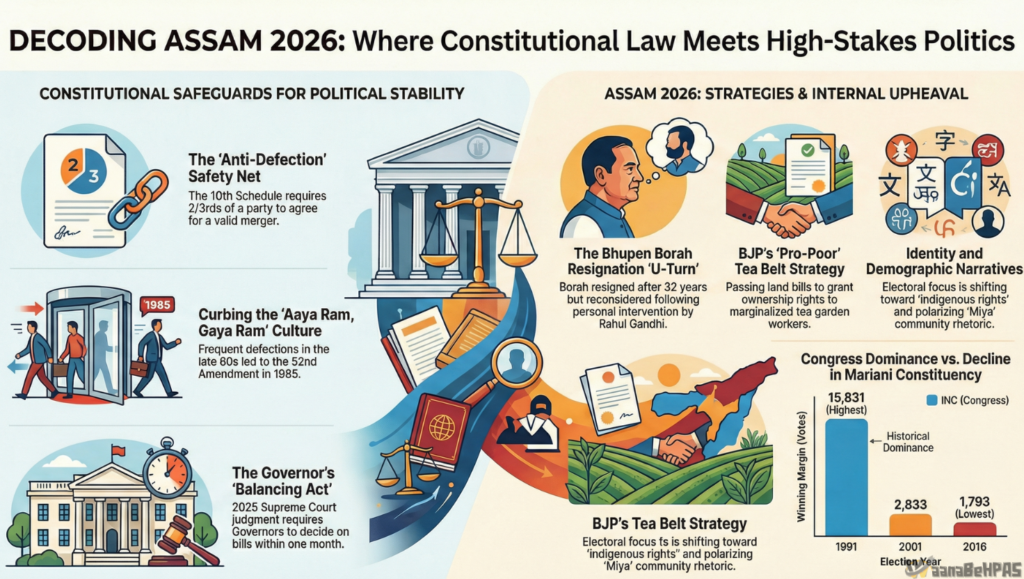
The anti-defection law (1985, amended 2003) intended stability but produced distortions:
- Individual defections penalized
- Two-thirds “merger” loophole legalizes mass defections
- Speaker as adjudicator → risk of bias
Recent court observations suggest need for an independent tribunal to preserve legislative integrity.
This structural vulnerability directly affects state politics like Assam.
5️⃣ Case Study: Assam’s Political Realignment (2025–2026)
5.1 Bhupen Borah Resignation Saga
Former Assam Congress chief Bhupen Borah resigned citing “self-respect” concerns, only to reconsider after party mediation.
This episode reveals:
- Internal factionalism within Congress
- Central leadership intervention in state politics
- Strategic outreach by BJP
Chief Minister Himanta Biswa Sarma publicly invited Borah to join BJP, framing Congress as divided and elite-driven.
Electoral Implications:
- Weakens opposition morale
- Reinforces perception of BJP dominance
- Encourages strategic defections
5.2 Identity as Electoral Currency
Assam politics is deeply rooted in:
- Indigenous identity
- Tea tribe mobilization
- Demographic anxieties
- Immigration debates
Tea Tribe Politics
The Assam Fixation of Ceiling on Land Holdings (Amendment) Bill, 2025 granting land pattas to tea garden workers:
- Strengthens BJP’s pro-poor narrative
- Repositions party as custodian of indigenous rights
- Expands electoral base
However, polarization has consequences:
Social Impacts
- Economic disruption (labor mobility constraints)
- Communal insecurity
- Youth radicalization
- Governance trust deficit
Identity remains the primary operational driver of electoral behavior.
6️⃣ Federalism Meets Electoral Strategy
Assam illustrates how:
- Centralized party leadership influences state politics
- Defection politics destabilizes opposition
- Governors and constitutional tools can become friction points
- Identity narratives reshape federal dynamics
The BJP’s model combines:
✔ Organizational consolidation
✔ Identity co-option
✔ Welfare expansion
✔ Strategic opposition fragmentation
Meanwhile, Congress faces:
⚠ Leadership crisis
⚠ Organizational erosion
⚠ Dependence on central mediation
7️⃣ Structural Lessons for Indian Federalism
Assam’s developments highlight broader federal realities:
A. Regime-Centric vs Institutional Federalism
When national parties dominate states, federalism becomes politically centralized.
B. Operational vs Constitutional Federalism
While constitutional safeguards exist, operational reality depends on:
- Political pluralism
- Judicial vigilance
- Coalition dynamics
C. Rise of Competitive Federalism
State-level identity politics shapes national coalitions.
8️⃣ Reform Imperatives
Drawing from Punchhi Commission:
- Remove “pleasure doctrine” ambiguity for Governors
- Make Governor removal accountable to State legislature
- Depoliticize Raj Bhavans
- Reform anti-defection adjudication mechanism
Federal equilibrium depends on reducing political misuse of constitutional offices.
9️⃣ UPSC Analytical Themes
GS-II
- Federalism: cooperative vs competitive
- Governor’s role and constitutional morality
- Article 356 limitations
- Anti-defection law reforms
GS-III
- Identity politics and internal security
- Electoral polarization and governance
Essay
- “Federalism in India: Between central dominance and regional assertion”
- “Identity and democracy in a plural society”
🔟 Conclusion: Federalism as a Dynamic Process
Assam’s political turbulence is not merely an electoral contest; it is a reflection of India’s evolving federal equilibrium.
India’s Constitution provides a carefully calibrated hybrid structure. Yet the preservation of federal balance depends not on textual provisions alone, but on:
- Political restraint
- Institutional neutrality
- Judicial vigilance
- Elite accommodation
The shift from one-party dominance to coalition pluralism and now to dominant-party federalism demonstrates that federalism in India is a living negotiation.
If operational reality diverges too far from constitutional ideals, the legitimacy of the Union itself may erode.
Assam, therefore, serves as a microcosm of India’s federal experiment—where electoral strategies, identity mobilization, and constitutional guardrails converge in shaping the future of cooperative federalism.