Uniform Civil Code (UCC): A Clear and Complete Guide for Aspirants
Introduction
The Uniform Civil Code (UCC) is one of the most important and debated topics in Indian polity. It is not just about law, but also about equality, justice, secularism, and national unity. The idea of UCC aims to bring all citizens under a single legal framework in personal matters, irrespective of their religion.
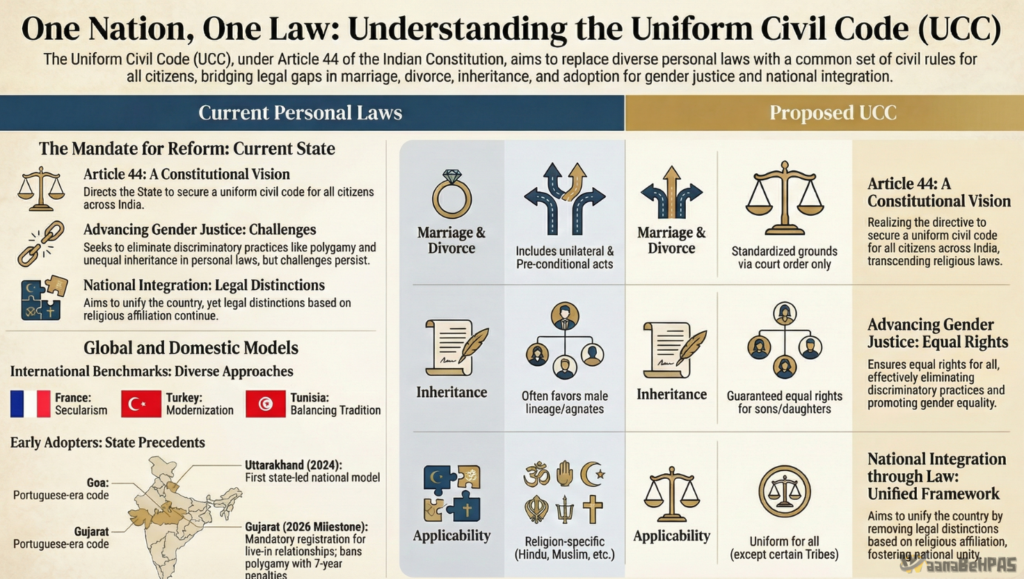
At present, India follows different personal laws for different religious communities. These laws deal with matters such as marriage, divorce, inheritance, adoption, and maintenance. Because of this, people are treated differently based on their religion. The UCC proposes to remove this difference and establish a common system of laws for everyone.
What is Uniform Civil Code?
The Uniform Civil Code refers to a single set of civil laws applicable to all citizens of India in personal matters.
It covers areas like:
- Marriage and divorce
- Inheritance and succession
- Adoption
- Maintenance and guardianship
Currently, these matters are governed by religion-based laws such as Hindu law, Muslim law, Christian law, etc. This creates a system where different rules apply to different people.
Why is UCC important?
- Ensures equality before law
- Promotes national unity
- Strengthens secularism
- Simplifies the legal system
Constitutional Provisions Related to UCC
The concept of UCC is mentioned in Article 44, which is part of the Directive Principles of State Policy (DPSP).
It states that:
The State shall endeavour to secure a uniform civil code for all citizens.
Key Points to Understand:
- DPSPs are not legally enforceable
- But they are important for governance
- The State has a duty to try to implement them
Conflict in the Constitution
There is a clear tension between:
- Articles 25–28 → Freedom of religion
- Article 44 → Uniform civil laws
Understanding the Balance
- Religious practices should be respected
- But practices that violate equality and dignity need reform
This shift is often described as moving from religious morality to constitutional morality.
Historical Background of UCC
The current system of personal laws has its roots in British rule.
During British Period:
- British avoided interfering in religious matters
- They introduced uniform laws in:
- Criminal law
- Contracts
- But allowed personal laws to remain separate
Important Developments:
- 1835 – Lex Loci Report
Suggested uniform laws but excluded personal laws - 1858 – Queen’s Proclamation
Promised non-interference in religion - 1937 – Shariat Act
Applied Islamic law to Muslims - 1940s – B.N. Rau Committee
Suggested reform in Hindu laws
Role of Constitution Makers
Leaders like B. R. Ambedkar strongly supported the idea of a Uniform Civil Code.
Their Vision:
- Create a modern and equal society
- Remove discriminatory practices
- Ensure women’s rights
However, due to opposition, only Hindu laws were reformed in the 1950s through the Hindu Code Bills. Other communities continued with their personal laws.
Role of Supreme Court in Promoting UCC
In the absence of a national law, the Supreme Court has played a key role in pushing for reforms.
Important Judgments:
- Shah Bano Case (1985)
- Muslim woman granted maintenance
- Court emphasized need for UCC
- Sarla Mudgal Case (1995)
- Prevented misuse of religion for second marriage
- Shayara Bano Case (2017)
- Triple Talaq declared unconstitutional
- Kamla Neti Case (2022)
- Highlighted inequality faced by tribal women
What do these cases show?
- UCC is not just about unity
- It is important for gender justice and equality
State-Level Developments
Some Indian states have started experimenting with UCC-like laws.
Examples:
- Goa
- Only state with a uniform civil law
- Based on Portuguese Civil Code
- Uttarakhand (2024)
- Mandatory marriage registration
- Live-in relationships must be registered
- Gujarat (2026)
- Similar provisions
- Strict punishment for bigamy
Concerns:
- Mandatory registration may affect Right to Privacy (Article 21)
- Risk of misuse against interfaith or intercaste couples
Global Perspective on UCC
Many countries have adopted uniform civil laws while respecting diversity.
Examples:
- France
- Strict separation of religion and state
- Turkey
- Adopted civil code in 1926
- Tunisia
- Banned polygamy
- Canada
- One civil law for all
Key Learning:
- Diversity can exist
- But laws must ensure equality
Arguments in Favour of UCC
1. Gender Justice
- Removes discrimination against women
- Ensures equal rights in marriage and inheritance
2. Equality Before Law
- Same laws for all citizens
3. National Integration
- Reduces division based on religion
4. Simpler Legal System
- One law is easier to understand and implement
Arguments Against UCC
1. Threat to Minority Rights
- Fear of majority dominance
2. Loss of Cultural Identity
- India has diverse traditions
3. Tribal Concerns
- Tribal customs may be ignored
Challenges in Implementation
Implementing UCC is difficult due to:
1. Diversity
- India has many religions and communities
2. Religious Sensitivity
- Personal laws are emotionally important
3. Constitutional Issues
- Conflict between religion and equality
4. Privacy Concerns
- State interference in personal matters
Way Forward
A balanced and careful approach is needed.
Suggested Steps:
- Gradual Implementation
- Avoid sudden changes
- Optional UCC
- Allow people to choose it voluntarily
- Reform Within Communities
- Encourage internal changes
- Consultation
- Include minorities and tribal groups
- Focus on Equality
- Remove discrimination first
Conclusion
The Uniform Civil Code is an important step toward building a more equal and just society. However, it must be implemented carefully, keeping in mind India’s diversity.
The goal should not be to remove cultural differences, but to ensure that no tradition violates the fundamental rights of individuals. A well-planned UCC can help India move toward true equality, where every citizen is treated with dignity and fairness.