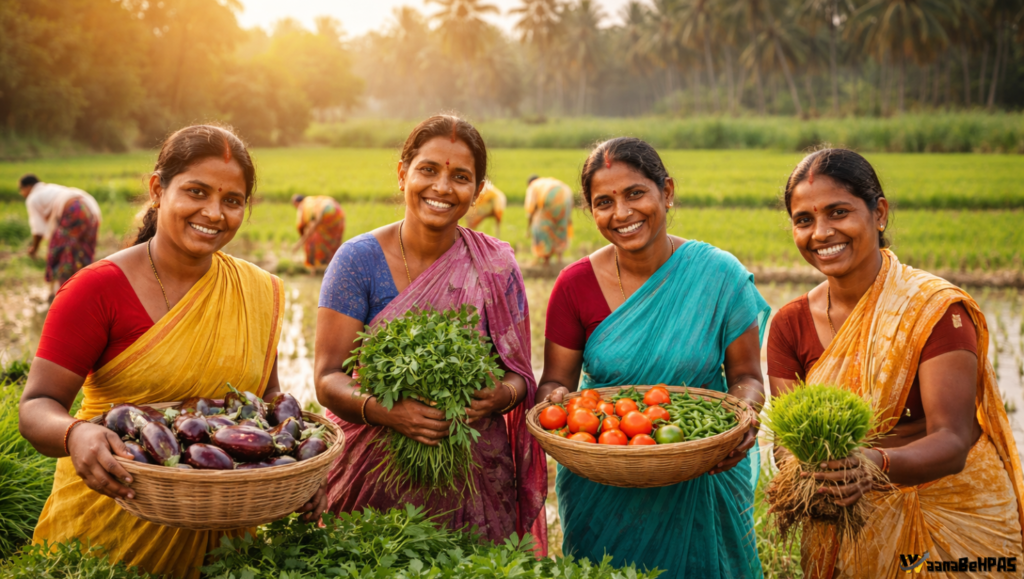
Global Conference on Women in Agri-Food Systems (GCWAS-2026): Advancing Gender Equality and Food System Resilience
Introduction
The Global Conference on Women in Agri-Food Systems (GCWAS-2026), held from 12–14 March 2026 in New Delhi, represents a major international initiative aimed at transforming the role of women in agriculture and global food systems. The conference is organized primarily by the Indian Council of Agricultural Research (ICAR) along with the Trust for Advancement of Agricultural Sciences (TAAS), and partners including the Consultative Group on International Agricultural Research (CGIAR) and the Protection of Plant Varieties and Farmers’ Rights Authority (PPV&FRA).
The event is inaugurated by Droupadi Murmu, President of India, highlighting its national and international significance. The conference aligns with the United Nations’ declaration of 2026 as the International Year of the Woman Farmer, marking a strategic shift toward recognizing women as central architects of resilient, sustainable, and inclusive agri-food systems.
Beyond advocacy, GCWAS-2026 focuses on concrete policy solutions, technological innovations, and institutional reforms to address long-standing gender disparities in agriculture.
Strategic Importance of GCWAS-2026
The conference serves as a global policy platform to translate discussions on gender equality in agriculture into scalable actions and institutional reforms.
Key strategic objectives include:
- Promoting women’s leadership and entrepreneurship in agriculture
- Facilitating global collaboration among governments, researchers, and farmer organizations
- Strengthening gender-responsive agricultural policies
- Enhancing technology access and financial inclusion
- Building resilient food systems through inclusive governance
Global thought leaders participating in the conference include experts such as:
- Agnes Kalibata – Founder, Connect4Impact
- Ismahane Elouafi – Executive Managing Director, CGIAR
- Soumya Swaminathan – Chairperson, MSSRF
- Shakuntala H. Thilsted – World Food Prize Laureate
Their participation reflects the conference’s aim of shaping global agricultural transformation through gender-inclusive policies.
The “Backbone Paradox” in Global Agriculture
Women constitute the backbone of agriculture, yet remain economically and socially marginalized. This contradiction is often described as the “Backbone Paradox”.
Key Global and Regional Statistics
| Indicator | Global / South Asia | India |
|---|---|---|
| Share in agricultural workforce | 43% globally | ~80% of economically active women |
| Contribution to food production | 60–80% in developing countries | ~75% crop production |
| Role in livestock sector | Significant participation | ~95% of animal husbandry |
| Land ownership | Less than 2% globally | ~11% women vs. 53% men |
Despite their contribution, women’s work is frequently classified as domestic support rather than formal agricultural labour, limiting recognition and access to benefits.
Feminization of Agriculture
A major structural trend shaping agriculture is the “feminization of agriculture.”
This occurs due to:
- Male migration to cities
- Increasing responsibility of women in farm management
- Growth of female-headed rural households
However, women often manage farms without legal recognition as farmers, restricting their access to:
- Agricultural subsidies
- Institutional credit
- Crop insurance
- Extension services
Thus, the feminization of agriculture often increases responsibility without increasing empowerment.
Structural Barriers to Women’s Economic Agency
1. Land Ownership
Land ownership is the foundation of agricultural empowerment because it determines:
- Eligibility for institutional credit
- Access to subsidies
- Social recognition as a farmer
However, women own only a small fraction of agricultural land, creating a “Thin File Problem”—women cultivate land but lack formal documentation needed for financial inclusion.
2. Limited Access to Credit
Without land titles as collateral, women farmers face:
- Restricted access to bank loans
- Dependence on informal moneylenders
- Difficulty investing in modern technologies
This limits productivity and perpetuates rural poverty.
3. Technological and Institutional Gaps
Women often have limited access to:
- Agricultural mechanization
- Training and extension services
- Market information systems
- Digital platforms
Additionally, patriarchal norms reduce their decision-making power within households and communities.
Government Initiatives Supporting Women Farmers
The Government of India has introduced targeted policies to address gender inequality in agriculture.
1. Mahila Kisan Sashaktikaran Pariyojana (MKSP)
MKSP focuses on:
- Skill development for women farmers
- Strengthening rural women’s collectives
- Promoting sustainable agricultural practices.
2. Sub-Mission on Agricultural Mechanisation (SMAM)
This initiative promotes women-friendly farm equipment, reducing drudgery and allowing women to focus on entrepreneurial and managerial roles.
3. National Food Security Mission (NFSM)
NFSM mandates that 30% of its budget is earmarked for women farmers, ensuring targeted investment in their training and productivity.
Technology and Digital Innovation: The Future of Inclusion
Technological innovation is emerging as a game-changer for women’s financial inclusion.
One example is the KhetScore digital credit model, developed through collaboration between IFPRI and Dvara E-Registry.
How it works
Instead of requiring land titles, the system uses:
- Satellite imagery
- Georeferenced farm photographs
- Plot-level productivity data
This allows financial institutions to assess creditworthiness without formal land ownership.
Key findings
- Women showed greater willingness to apply for loans under digital credit scoring systems.
- When combined with crop insurance, women’s desired loan size increased significantly, indicating higher economic confidence.
However, digital adoption requires addressing barriers such as:
- Smartphone access
- Mobility restrictions
- Digital literacy gaps.
Collective Empowerment Through Farmer Producer Organizations (FPOs)
Collective institutions such as Farmer Producer Organizations (FPOs) play a vital role in empowering women farmers.
FPOs allow women to:
- Pool resources
- Access markets collectively
- Negotiate better prices
- Share technical knowledge.
Successful Models
Samarpan Jeevika (Bihar)
Produces Nutri Garden Seed Kits using automated machinery.
Maikal Women Poultry (Madhya Pradesh)
Operates backyard broiler farming under the “Sukhtava Chicken” brand.
Aaranyak Agri (Bihar)
Uses NCDEX-linked aggregation platforms to secure 15–20% higher maize prices.
Koushikee Mahila Milk Producer Company (Bihar)
Provides transparent milk payments and food safety systems for over 5,500 women members.
These models demonstrate how collective organizations provide scale, bargaining power, and financial inclusion.
Climate Change and Gendered Vulnerability
Climate change disproportionately affects women farmers.
Female-led households face:
- Higher vulnerability to heat stress
- Crop losses due to erratic rainfall
- Increased labour burden.
Globally, heat stress alone is estimated to cause $37 billion in income losses annually for female-led households.
Climate Resilience Initiatives
Programs such as the ENACT project in Assam demonstrate gender-responsive climate adaptation strategies.
Key components include:
- Mobile-based weather advisories
- Climate Adaptation Information Centres
- Introduction of climate-resilient crop varieties
- Diversification of livelihoods.
Such interventions reduce the “Triple Burden” faced by women:
- Agricultural labour
- Domestic responsibilities
- Climate-related stress.
Link with Sustainable Development Goals
GCWAS-2026 contributes directly to several UN Sustainable Development Goals.
SDG-5: Gender Equality
Promotes women’s participation in decision-making and economic empowerment.
SDG-2: Zero Hunger
Women farmers play a critical role in improving food production and nutrition security.
SDG-1: No Poverty
Empowering women in agriculture leads to higher household incomes and improved rural livelihoods.
Strategic Roadmap Emerging from GCWAS-2026
The conference outlines a global roadmap for the next decade.
1. Institutionalize Sex-Disaggregated Data
Agricultural policies must include gender-specific data collection to measure impact effectively.
2. Expand Digital Credit Systems
Scaling models like KhetScore can bypass traditional barriers linked to land ownership.
3. Strengthen Women-Led Collectives
Encouraging women-exclusive FPOs and targeting 40% female leadership in agricultural institutions.
4. Promote Gender-Transformative Technologies
Develop tools and innovations designed specifically to reduce women’s labour burden.
5. Integrate Gender into Climate Policies
Climate-smart agriculture programs should prioritize female-led households and women farmers.
Conclusion
The Global Conference on Women in Agri-Food Systems (GCWAS-2026) marks a decisive step toward transforming agriculture into a more inclusive, equitable, and resilient sector. By addressing structural inequalities in land ownership, financial access, technology, and climate resilience, the conference emphasizes that empowering women farmers is not merely a social objective but a strategic necessity for global food security.
Recognizing women as proactive agents of change rather than invisible labourers will be essential for building sustainable food systems and achieving the broader goals of economic development and environmental sustainability.