West Asia Conflict, Maritime Security and India’s Strategic Interests
Syllabus: UPSC GS-II (International Relations), GS-III (Maritime Security)
1. Introduction
The West Asian region is one of the most strategically significant yet volatile geopolitical theatres. Escalating tensions involving Iran, Israel, and regional actors have transformed the region’s maritime routes into contested security zones. For India, which relies heavily on West Asian trade and energy imports, instability in the region directly affects economic growth, energy security, and the safety of millions of Indian citizens working abroad.
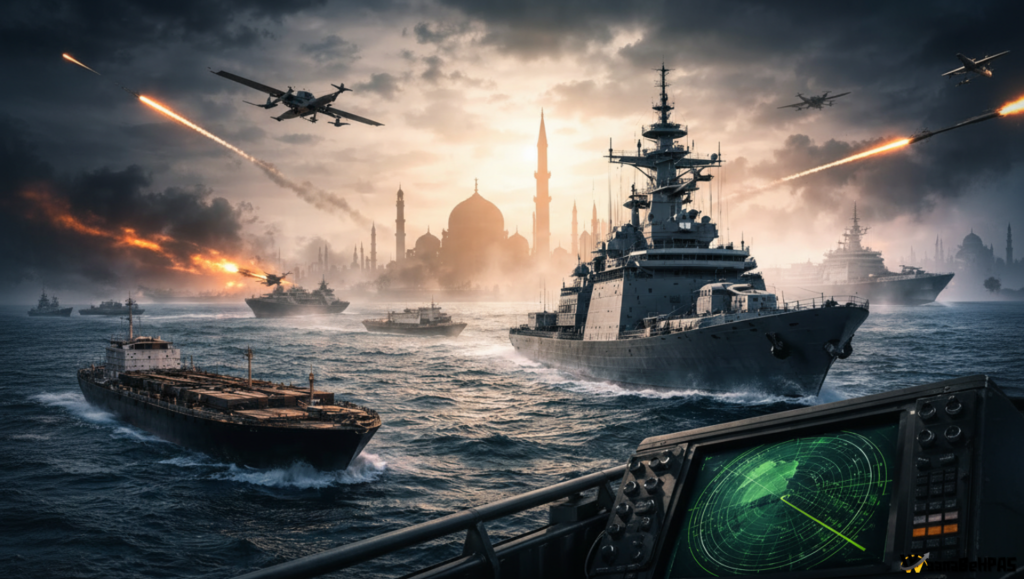
At the same time, the maritime domain is witnessing a transformation in threat dynamics—from traditional piracy to technologically sophisticated hybrid warfare involving drones, missiles, and unmanned vessels. Recognizing these emerging risks, the Directorate General of Shipping introduced SOP-MARSEC-2024, a comprehensive framework aimed at strengthening vessel security and mitigating hybrid maritime threats.
Thus, understanding the intersection of West Asian geopolitics and maritime security architecture is crucial for safeguarding India’s strategic interests.
2. Strategic Importance of West Asia for India
West Asia occupies a central position in India’s foreign policy due to energy, trade, diaspora and connectivity considerations.
(a) Energy Security
Energy imports form the backbone of India’s relationship with West Asia.
- Over 50% of India’s crude oil imports originate from the Gulf region.
- Countries like Saudi Arabia, Iraq, UAE and Kuwait are major suppliers.
- The Strait of Hormuz, through which a significant portion of global oil supply passes, is a critical maritime chokepoint.
Any disruption in these shipping lanes due to conflict can result in:
- rising oil prices
- inflationary pressures
- economic slowdown.
(b) Indian Diaspora
The Gulf region hosts the largest overseas Indian population.
- Around 9–10 million Indians reside in West Asian countries.
- They contribute significantly through remittances to India’s economy.
In times of conflict, the Indian government must ensure:
- evacuation operations
- diplomatic protection
- emergency humanitarian support.
(c) Trade and Economic Connectivity
West Asia is among India’s largest trading partners.
- The Gulf Cooperation Council (GCC) is a major trade bloc for India.
- Key exports include petroleum products, food grains, textiles and machinery.
Regional conflicts disrupt:
- shipping routes
- insurance coverage
- supply chains
This highlights the importance of maritime security for uninterrupted commerce.
(d) Strategic Connectivity Projects
West Asia also serves as a gateway connecting India to Europe, Central Asia and Africa.
Important projects include:
Chabahar Port (Iran)
Provides India access to Afghanistan and Central Asia bypassing Pakistan.
International North-South Transport Corridor (INSTC)
Connects India with Russia and Europe through Iran.
India-Middle East-Europe Economic Corridor (IMEC)
A proposed trade corridor linking India to Europe through Gulf nations.
Any instability in the region may delay or disrupt these strategic initiatives.
3. Maritime Domain: Emerging Security Threats
The maritime domain has entered an era of growing volatility, where commercial shipping routes are increasingly targeted by state-linked proxies and non-state actors.
According to the Maritime Security Review 2024, incidents increased from:
- 161 incidents in 2022
- 227 incidents in 2024
This sharp rise reflects the changing nature of maritime threats.
Evolution of Maritime Threats
| Feature | Classical Piracy | Hybrid Threats |
|---|---|---|
| Weapons | Knives, blunt weapons, firearms | Missiles, drones, explosives |
| Operational Range | Near coastal waters | Extended blue-water range |
| Objective | Theft or ransom | Strategic disruption |
| Platforms | Small skiffs | Drones, USVs |
Thus, modern maritime threats increasingly resemble hybrid warfare rather than conventional piracy.
4. Maritime Security SOP-MARSEC-2024
To address these emerging threats, India introduced SOP-MARSEC-2024 (Standard Operating Procedure for Vessel Hardening and Hybrid Threat Mitigation).
The SOP aims to strengthen security across critical maritime regions including:
- Indian Ocean Region (IOR)
- Red Sea
- Gulf of Aden
- Gulf of Guinea
It applies to:
- Indian-flagged commercial vessels
- foreign vessels with Indian seafarers
- vessels entering Indian ports.
5. Enhanced Watchkeeping and Surveillance Protocols
A key insight from maritime threat analysis is that 75% of attacks occur during nighttime, exploiting gaps in surveillance.
Therefore, SOP-MARSEC-2024 mandates strict watchkeeping measures.
Key Watchkeeping Protocols
Shift Overlap System
- Minimum 20-minute overlap during watch changes to prevent security gaps.
Night Surveillance Technology
- Mandatory use of infrared binoculars and night-vision devices.
Radar Optimization
- Radar systems must be tuned to detect small fiberglass boats and low radar-signature vessels.
Anchorage Security
- In high-risk areas like the Bay of Bengal, vessels must conduct two-person patrols every 30 minutes.
These measures aim to strengthen human and technological vigilance.
6. Technological Hardening and AI-Enabled Surveillance
Modern threats increasingly involve drones and unmanned vessels. Therefore, passive surveillance is insufficient.
SOP-MARSEC-2024 recommends AI-enabled maritime monitoring systems.
Mandatory CCTV Placement
CCTV systems must cover:
- engine rooms
- cargo holds
- access points and gangways
- the ship’s bridge.
AI Integration
AI-enabled systems provide:
- automatic detection of suspicious vessels
- drone identification
- real-time alerts to the bridge.
This transforms surveillance from passive recording to active threat detection.
7. Citadel Fortification and Crew Protection
The citadel is the secure refuge where crew members retreat during an attack.
Recent incidents show attackers using gas cutters and tools to breach citadel doors. SOP-MARSEC-2024 therefore mandates structural reinforcement.
Citadel Hardening Measures
- Internal door hinges protected by steel plates
- heavy-duty internal locking systems
- secure ventilation with gas protection
- independent communication systems.
A fortified citadel can sustain crew safety for up to 40 hours, allowing time for naval rescue operations.
8. Integrated Maritime Response Framework
Maritime security requires coordination between ships and national agencies.
Incident Reporting Protocol
In case of threat, the ship’s master must:
- Issue MAYDAY call on VHF Channel 16
- Contact Information Fusion Centre – Indian Ocean Region (IFC-IOR)
- Notify Mercantile Marine Domain Awareness Centre (MMDAC)
- Alert DG Communication & LRIT Centre
Information sharing enables rapid response by the Indian Navy and regional partners.
9. Implications for India’s Strategic Interests
The convergence of West Asian geopolitical tensions and maritime threats has several implications.
Energy Security
Shipping disruptions threaten India’s oil imports.
Trade Stability
Insecure sea lanes increase shipping costs and disrupt exports.
Diaspora Protection
Millions of Indians working in the Gulf may require evacuation during crises.
Strategic Projects
Connectivity initiatives like INSTC and IMEC depend on secure maritime routes.
10. Way Forward
To safeguard its interests, India must adopt a multi-layered strategy.
Energy Diversification
- Increase renewable energy
- diversify oil import sources.
Maritime Domain Awareness
- expand satellite monitoring
- strengthen naval presence in the IOR.
Regional Cooperation
- collaborate with Gulf nations and international partners.
Technological Security
- deploy AI-based maritime surveillance systems.
Diaspora Protection Mechanisms
- strengthen evacuation preparedness.
11. Conclusion
The evolving geopolitical crisis in West Asia highlights the strategic importance of maritime security for India. With a large diaspora, critical energy dependence, and growing trade networks, the stability of sea routes remains central to India’s national interests.
The introduction of SOP-MARSEC-2024 represents a proactive shift from passive defense to resilient maritime security architecture, combining technological surveillance, structural fortification, and coordinated naval response.
In an era where commercial shipping routes have become arenas of geopolitical competition, protecting maritime trade corridors is not merely a security requirement but a strategic imperative for India’s economic and geopolitical stability.
UPSC Mains Practice Question
Q.
“The security of maritime trade routes has become central to India’s strategic interests in the context of rising geopolitical tensions in West Asia.” Discuss the role of maritime security frameworks such as SOP-MARSEC-2024 in addressing emerging hybrid threats. (250 words)