India’s Internal Security Architecture: Challenges, Responses and Lessons from Contemporary Incidents
Syllabus: UPSC GS-II & III (Polity, Security and Defence & Disaster Management)
Introduction: Internal Security as a Pillar of National Stability
India’s internal security landscape is a complex and evolving mosaic, shaped by historical grievances, socio-economic disparities, regional aspirations, and persistent external interference. Unlike conventional security threats, internal security challenges operate across multiple domains—ideological extremism, ethno-nationalist insurgencies, terrorism, governance deficits, and disaster response capabilities.
In this context, routine military incidents, such as the recent Indian Air Force (IAF) trainer aircraft crash in Prayagraj, though non-combat in nature, offer important insights into national security preparedness, civil-military coordination, and administrative resilience. When viewed alongside enduring challenges like Left-Wing Extremism (LWE), North-East insurgencies, and terrorism in Jammu & Kashmir, such incidents help illustrate the breadth of India’s internal security ecosystem.
The IAF Trainer Aircraft Crash: A Contemporary Security and Governance Case Study
Incident Overview
A trainer aircraft of the Indian Air Force crashed into a water body in Prayagraj, Uttar Pradesh, during a routine training sortie. Both pilots were successfully rescued, and a Court of Inquiry was instituted to ascertain the cause, including possible technical failure or human factors.
Security & Defence Significance (GS-III)
- Highlights operational risks inherent in military training, even outside combat zones
- Reinforces the importance of high safety standards, maintenance protocols, and pilot preparedness
- Demonstrates the role of training institutions in sustaining long-term defence readiness
Disaster Management & Administration (GS-III)
- Swift coordination between the IAF, local administration, fire services, and the National Disaster Response Force
- Illustrates multi-agency emergency response, a key component of India’s disaster management framework
- Shows preparedness for accidental disasters, which are integral to internal security planning
Polity & Governance (GS-II)
- Reflects healthy civil-military relations, transparency, and accountability
- Reinforces the armed forces’ role not only in war-fighting but also in peacetime governance and crisis response
UPSC Value Addition:
The incident can be cited as a current example in answers on internal security preparedness, disaster response, or role of armed forces in aid to civil authorities.
Left-Wing Extremism (LWE): Internal Security Rooted in Governance Deficits
Nature of the Threat
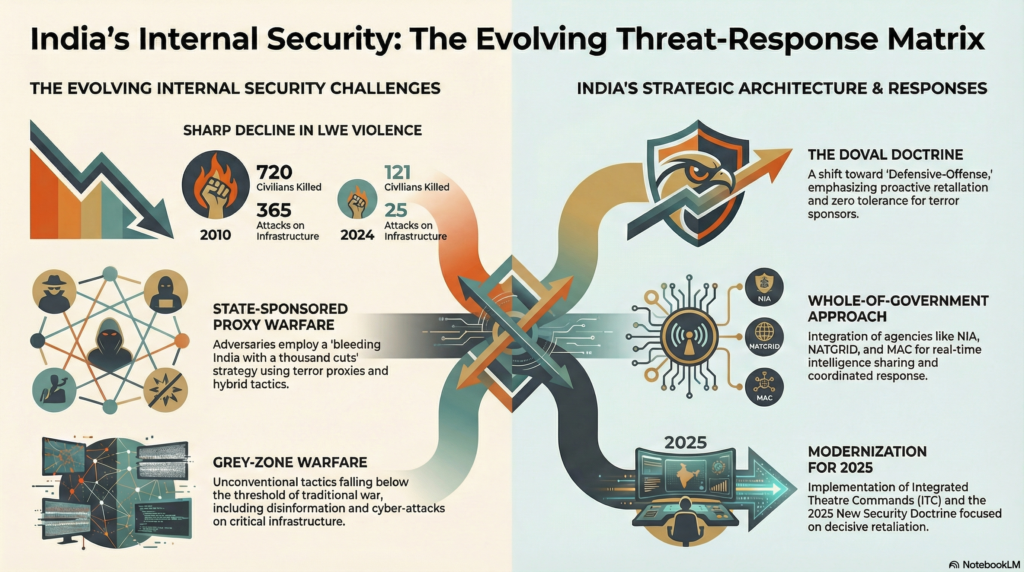
Left-Wing Extremism, often termed India’s gravest internal security challenge, is not merely a law-and-order problem but a manifestation of deep socio-economic and governance failures. The Maoist ideology thrives in regions marked by poverty, alienation, and administrative absence.
Core Drivers
- Developmental alienation: Displacement due to mining and infrastructure projects without adequate rehabilitation
- Governance failure: Poor implementation of Fifth Schedule provisions, PESA Act, and Forest Rights Act
- Social exclusion: Erosion of tribal dignity and weak political representation
These factors create a vicious cycle where underdevelopment fuels extremism, and extremism further obstructs development.
Government Response: A Holistic Strategy
India has moved beyond a purely coercive approach to a multi-layered security-development model, anchored in:
- Targeted security operations (CAPFs, COBRA, Greyhounds)
- Developmental interventions (road connectivity, mobile towers, Eklavya schools)
- Perception management through surrender-cum-rehabilitation policies and civic action programmes
This approach mirrors the principle seen in the Prayagraj IAF incident—security effectiveness is maximized when administrative capacity and coordination are strong.
Regional Insurgencies: The North-East and Jammu & Kashmir
North-East India: From Force to Dialogue
Insurgencies in the North-East stem from:
- Ethnic identity anxieties
- Historical neglect
- Demographic fears and porous borders
The government’s approach combines:
- Limited use of Armed Forces Special Powers Act
- Peace accords and Suspension of Operations agreements
- Developmental integration through the Act East Policy
The result has been a substantial decline in violence, validating a governance-plus-security model.
Jammu & Kashmir: Terrorism and External Sponsorship
The insurgency in J&K is distinct due to:
- Systematic external state sponsorship, particularly by Pakistan’s ISI
- Use of hybrid terrorists, OGWs, and propaganda networks
Post-2019, the abrogation of Article 370 marked a strategic shift towards:
- Full legal and political integration
- Proactive counter-terror operations
- Development-led stabilization
External Dimension: Proxy Warfare and Grey-Zone Threats
India’s internal security is inseparable from its external environment:
- Pakistan employs proxy terrorism as a low-cost strategy
- China allegedly exploits internal fault lines through ideological and grey-zone tactics
- Terror outfits like LeT and JeM use technology, drones, and online radicalization
This evolving threat landscape demands continuous adaptation, similar to how aviation safety protocols are reviewed after incidents like the IAF trainer crash.
Strategic Lessons and Way Forward
Key Takeaways for UPSC
- Security is multidimensional: Military readiness, governance, development, and disaster response are interlinked
- Governance is the first line of defence: Poor administration creates security vacuums
- Civil-military coordination matters: From counter-insurgency to accident response
- Adaptive strategies are essential: Threats evolve faster than static doctrines
Way Forward
- Strengthen implementation of protective laws (FRA, PESA)
- Promote people-centric, participatory development
- Enhance security force sensitization and accountability
- Invest in counter-technology and intelligence capabilities
- Institutionalize lessons from non-combat incidents like military accidents into broader security planning
Conclusion
India’s internal security challenges—ranging from Left-Wing Extremism and regional insurgencies to terrorism and accidental disasters—require a holistic, governance-driven security architecture. The IAF trainer aircraft crash in Prayagraj, though limited in scale, reinforces a critical UPSC insight: national security is not only about fighting enemies but about preparedness, coordination, and institutional resilience.
For UPSC aspirants, integrating current incidents with structural analysis, as demonstrated here, is key to writing high-scoring, multidimensional answers.