India–Japan Strategic Cooperation
Syllabus: UPSC GS-II (Foreign policy) (India–Japan)
New Frameworks for AI and Critical Mineral Diplomacy(India–Japan)
Introduction
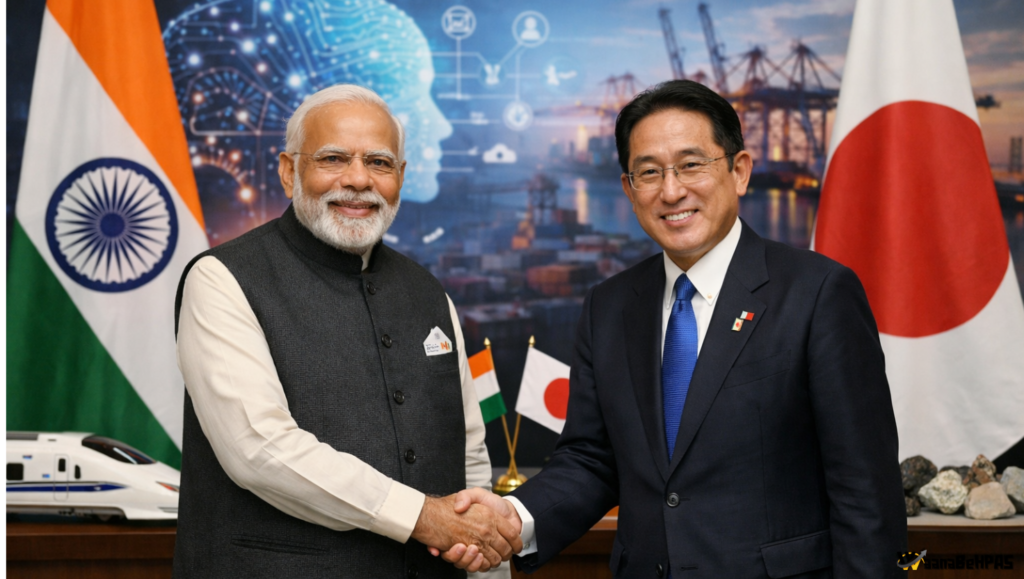
India and Japan (India-Japan) are expanding their Special Strategic and Global Partnership beyond traditional infrastructure and trade into the new domains of Artificial Intelligence (AI) and critical minerals.
The launch of an AI Dialogue and a Joint Working Group (JWG) on Critical Minerals during the 18th India–Japan Strategic Dialogue (New Delhi, January 2026) marks a shift toward economic security–driven diplomacy.
This cooperation reflects:
- Growing geopolitical competition in technology
- Vulnerable global supply chains
- Need for trusted partners in the Indo-Pacific
1. Why This Cooperation Matters – The Geostrategic Context
A. From Trade Partnership to Economic Security
Globalisation is increasingly being “weaponised.” Countries are using:
- export controls
- technology denial
- supply-chain dominance
as geopolitical tools.
Both India and Japan face risks due to:
- concentration of semiconductor and mineral supply in a few countries
- over-dependence on single manufacturing hubs
- strategic competition in the Indo-Pacific.
Hence, economic security has become the new pillar of bilateral ties.
B. Financial & Strategic Foundation
During PM Modi’s 2025 visit to Tokyo, Japan pledged $67.9 billion investment over 10 years, linking:
- Japan’s Free and Open Indo-Pacific (FOIP) vision
- India’s Atmanirbhar Bharat and technology missions.
New Institutional Mechanisms
| Mechanism | Objective |
|---|---|
| AI Dialogue | Joint research, governance norms, trustworthy AI |
| JWG on Critical Minerals | Rare earth sourcing, processing & stockpiling |
| Economic Security Dialogue | Managing technology & supply-chain risks |
| Private Sector Track | JETRO–CII–Keidanren industrial cooperation |
2. Artificial Intelligence: Towards “Networked Autonomy”
A. Why AI Cooperation?
AI is a general purpose technology like electricity or the internet.
No country can achieve total self-reliance due to:
- chip dependencies
- data gaps
- high compute costs.
India and Japan are adopting a model of Managed Interdependence—
cooperate globally but ensure sovereign outcomes.
B. India’s Strengths + Japan’s Strengths
| India | Japan |
|---|---|
| Huge talent pool | Advanced R&D |
| Large datasets | Precision manufacturing |
| Low-cost innovation | Robotics & hardware |
| Digital public infra | Industrial AI |
C. IndiaAI Mission Link
India’s ₹10,372 crore IndiaAI Mission focuses on:
- GPUs & compute infrastructure
- Indic language datasets
- AI governance
Japan can help in:
- model safety
- industrial AI
- ethical frameworks.
D. Quad AI Agriculture Example
India–Japan–US–Australia project on:
- disease detection
- yield forecasting
- climate-resilient crops
using Tiny ML & LLMs shows how multilateral AI can solve real problems.
Infographic

3. Critical Minerals – The “New Oil”
A. The Problem
- 90% of rare-earth processing is controlled by one country
- EVs, semiconductors, defence, renewables need these minerals
- 2010 export restrictions showed vulnerability.
B. India–Japan Response
August 2025 MoC on Critical Minerals created a JWG to:
- diversify sourcing
- promote joint exploration
- build processing capacity in India.
Complementary Roles
- Australia – resource base
- Japan – capital & technology
- India – manufacturing & reserves
- US – advanced tech
C. Success Story
Toyota Tsusho rare-earth refinery in Andhra Pradesh → model for domestic value addition.
4. Industrial Implementation – Eight Priority Sectors
Using tools like HHI & Product Complexity Index, both sides identified high-risk sectors:
1) Semiconductors
- Tokyo Electron–Tata Electronics partnership
- Renesas–CG Power OSAT in Gujarat.
2) Clean Energy
- Green ammonia at Mundra
- JBIC loan for bioethanol in Assam.
3) ICT & 5G
- Open RAN pilots
- Japan ICT Fund support.
4) Pharmaceuticals
- API diversification
- Japanese fermentation tech + Indian scale.
5) Infrastructure
- Mumbai–Ahmedabad Bullet Train (E10 Shinkansen – first outside Japan).
5. Challenges to Overcome
- High tariffs & NTBs
- Quality Control Orders
- Skill gaps
- Technology protection concerns
- Financing risks.
6. Way Forward – Five Imperatives
- From Dialogue to Delivery – clear timelines for JWG
- AI Governance – bias checks, safety audits
- Data × Compute Strategy – Indic datasets with GPU use
- Upgrade CEPA – remove NTBs
- Skill Mobility – expand TITP & R&D visas.
UPSC VALUE ADDITIONS
Link with Syllabus
GS Paper II
- India–Japan relations
- Indo-Pacific strategy
- Economic diplomacy
GS Paper III
- Critical minerals
- AI & emerging tech
- Supply chains & industrial policy
- Energy security
Possible Mains Questions
Q1. “Critical minerals are the new pivot of geopolitics.” Examine how India–Japan cooperation can reduce India’s strategic vulnerabilities.
Q2. Discuss the role of India–Japan AI Dialogue in balancing technological sovereignty and global interdependence.
Q3. Explain how economic security is reshaping India’s foreign policy with reference to Japan.
10 Prelims Facts
- JWG on Critical Minerals – India Ministry of Mines + Japan METI
- AI Dialogue launched in 2026
- Japan investment pledge – $67.9 billion
- Toyota Tsusho refinery – Andhra Pradesh
- Open RAN – alternative to vendor-locked 5G
- FOIP = Free and Open Indo-Pacific
- TITP – Technical Intern Training Program
- HHI – measures market concentration
- PCI – product complexity index
- Quad AI project – agriculture focus
Conclusion
India–Japan cooperation on AI and critical minerals is not routine diplomacy—it is the foundation of a new Indo-Pacific economic architecture.
It balances:
- growth with security
- technology with values
- autonomy with partnership.
For India, this partnership strengthens Atmanirbhar Bharat while keeping the door open to global innovation—exactly the kind of middle-path strategy UPSC looks for.