Ben Nevis: A Geological Chronicle and the Geographic Soul of Scotland1
Syllabus: UPSC GS-I (Physical Geography)
1. Introduction – The Vertical Monarch of the British Isles
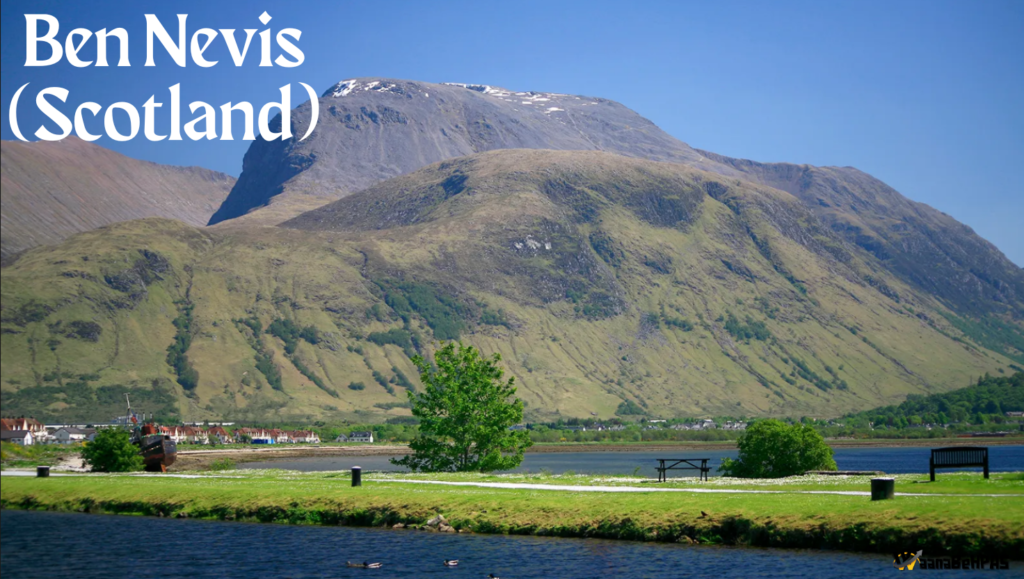
Ben Nevis, rising to 1,345 metres, is the highest mountain in the United Kingdom and a defining landmark of the Scottish Highlands. Situated near Fort William in the Grampian Mountains, it is not merely a peak but a multi-layered geological archive that records over 750 million years of Earth’s history. The mountain presents two contrasting faces—its southern aspect appears as a massive rounded dome, while the North Face exposes dramatic cliffs that reveal the remains of an ancient volcanic world. For UPSC geography, Ben Nevis offers a classic case study of how tectonics, volcanism, glaciation and climate interact to shape landscape.
2. Deep Geological Foundations
The Dalradian Basement
The roots of Ben Nevis lie in the Dalradian rocks (750–650 million years old) that began as sediments on the margins of the ancient continent Laurentia. These were later transformed by heat and pressure into:
- Schists and slates – forming smoother slopes
- Quartzites – extremely resistant, creating sharp ridges
- Marbles – remnants of ancient limestones
These varied rocks control the relief of the Highlands, explaining why some ridges endure while others are eroded into glens.
The Caledonian Orogeny
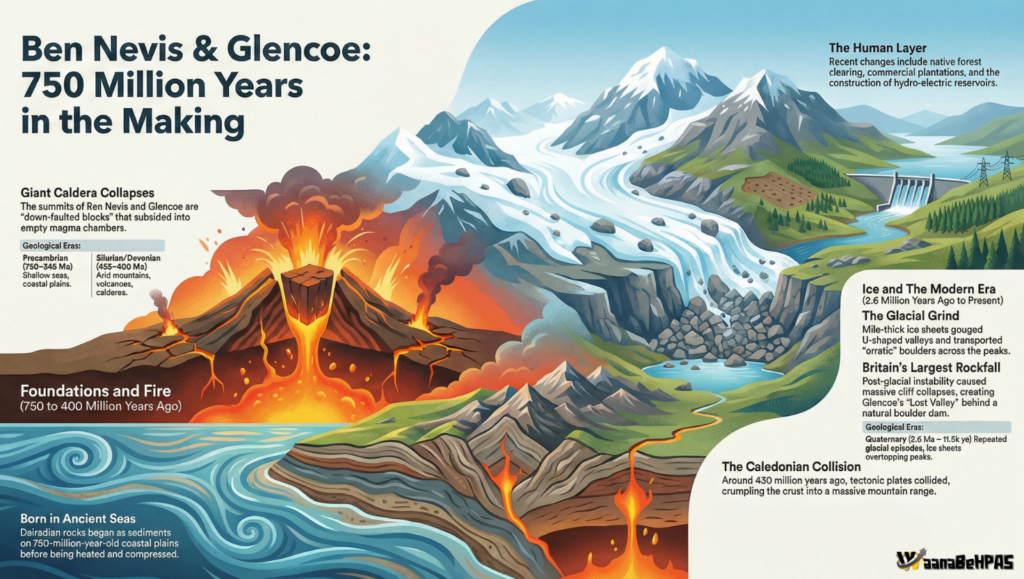
Between 470–430 million years ago, the collision of Laurentia, Baltica and Avalonia created the Caledonian mountain belt. Intense folding and faulting produced structures such as the Fort William Slide, upon which the Ben Nevis volcanic complex later developed. This links the mountain to the broader tectonic evolution of the British Isles and North Atlantic region.
3. The Ben Nevis Volcanic Complex
Ben Nevis represents the deeply eroded core of a major volcano formed around 420 million years ago.
- The mountain contains Outer and Inner Granites, intruded in multiple pulses.
- A dramatic process of cauldron subsidence occurred when a magma chamber emptied and the surface block collapsed along ring fractures.
- Within this down-faulted block are preserved:
- playa-lake sediments,
- volcanic breccias,
- thick andesite lava flows forming today’s summit plateau.
UPSC Concept Link: Ben Nevis–Glencoe region is a global type example for understanding caldera collapse and ring intrusions.
4. Glacial Architecture – The Final Sculptor
During the Quaternary Ice Age, a kilometre-thick ice sheet covered the Highlands.
Key glacial landforms around Ben Nevis:
- U-shaped valleys – Glen Nevis, Lairig Eilde
- Corries, arêtes and moraines
- Glacial striations above 900 m
After ice retreat (~11,500 years ago), post-glacial rebound raised former coastlines; raised beaches around Loch Linnhe provide evidence. Thus, the present landscape is largely a product of glacial geomorphology under a maritime climate.
5. Climate, Drainage and Ecology
- Climate: Temperate maritime alpine
- Rainfall often >3000 mm/year
- Frequent cloud, strong Atlantic winds
- Drainage: Rivers Nevis and Lochy flow to the Atlantic Ocean
- Ecosystem: peatlands, moorlands, remnants of native birch–pine forests
The mountain demonstrates how the North Atlantic Drift shapes Scotland’s mild yet extremely wet environment.
6. Scotland & UK – Key UPSC Linkages
Ben Nevis helps understand wider geography of Scotland:
- Highland–Lowland division of relief
- Influence of Atlantic currents on UK climate
- Abundant water resources → hydropower and lochs
- Sparse Highlands vs dense Central Lowlands (Glasgow–Edinburgh)
- Economy: tourism, fisheries, North Sea oil, renewable energy
- Strong tradition of conservation – John Muir Trust, National Trust for Scotland
Human impact is visible through slate quarrying at Ballachulish, hydro-electric schemes and managed trekking routes like the pony track.
7. Scientific and Strategic Importance
- International benchmark for volcanology and structural geology
- Rare vertical section from magma chamber to surface lavas
- Natural laboratory for studying:
- plate tectonics,
- glacial processes,
- climate–landform interaction.
Conclusion
Ben Nevis is a meeting point of ancient fire and recent ice—a mountain that explains Scotland’s physical identity. For UPSC, it exemplifies how old fold mountains modified by volcanism and glaciation operate within a temperate maritime setting, linking geomorphology with climate, resources and human geography of the United Kingdom.
- Question Reference
(HPAS PYQ 2025), Q. No. 21 ↩︎