
Government Appointments in Internal Security Forces (2026)
Strategic Leadership Succession and India’s Internal Security Architecture
1. Introduction: Why This Reshuffle Matters for UPSC
In January 2026, the Government of India, through the Appointments Committee of the Cabinet (ACC), carried out a major reshuffle of leadership in three of India’s most critical internal security institutions:
- Border Security Force (BSF)
- Indo-Tibetan Border Police (ITBP)
- National Investigation Agency (NIA)
This was not a routine bureaucratic change. It marked a strategic shift from ad-hoc, “additional charge” arrangements to long-term institutional leadership, signalling the government’s intention to build durable security capacity in an era of border tensions, terrorism, and hybrid warfare.
From a UPSC GS-2 and GS-3 perspective, this reshuffle directly relates to:
- Internal Security Architecture
- Border Management
- Role of Central Armed Police Forces
- Investigative agencies and counter-terrorism
- Executive authority in national security
2. Overview of the 2026 National Security Leadership Transition
The January 2026 leadership transition represents a high-stakes administrative pivot in India’s internal security system. By appointing full-time Directors General instead of temporary charge-holders, the government has moved from crisis-driven management to long-term strategic governance.
Leadership Matrix (2026)
| Agency | Director General | IPS Cadre | Tenure |
|---|---|---|---|
| Border Security Force (BSF) | Praveen Kumar | 1993, West Bengal | Till 30 Sept 2030 |
| National Investigation Agency (NIA) | Rakesh Aggarwal | 1994, Himachal Pradesh | Till 31 Aug 2028 |
| Indo-Tibetan Border Police (ITBP) | Shatrujeet Singh Kapoor | 1990, Haryana | Till 31 Oct 2026 |
This shows a clear differentiation of command horizons:
- BSF and NIA have long-term stability
- ITBP has a short transitional leadership
This asymmetry reflects the different security theatres India faces:
- Pakistan & Bangladesh borders (BSF)
- China’s LAC (ITBP)
- Internal terrorism and radicalisation (NIA)
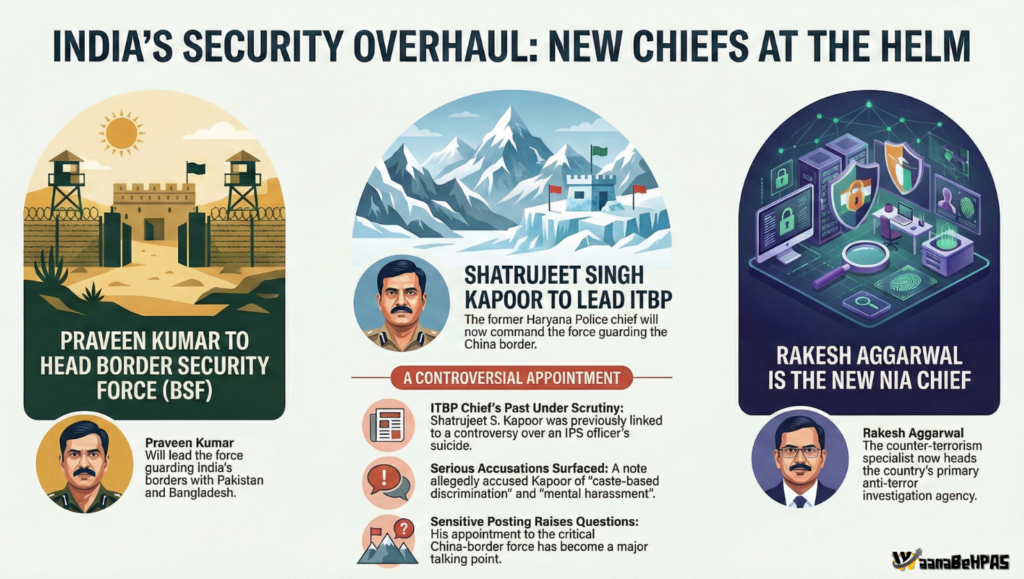
Infographic
3. Border Security Force (BSF): Institutional Continuity on Two Fronts
The BSF guards over 6,000 km of borders with Pakistan and Bangladesh, making it India’s largest and most critical border guarding force.
Appointment
Praveen Kumar (IPS, 1993, West Bengal cadre) was formally appointed DG, BSF on 15 January 2026, after already holding additional charge since November 2025.
Strategic Significance
His appointment is a classic example of continuity in command:
- He moved directly from DG-ITBP to DG-BSF
- He was already conducting operational reviews in Jammu & Kashmir even before formal confirmation
His retirement in 2030 gives BSF a rare four-year-plus leadership window, which is essential for:
- Implementing the Comprehensive Integrated Border Management System (CIBMS)
- Strengthening anti-drone and surveillance technologies
- Countering infiltration and narco-terrorism from Pakistan
- Managing illegal migration and smuggling on the Bangladesh border
For UPSC, this highlights the shift from reactive border policing to technology-driven border governance.
4. Indo-Tibetan Border Police (ITBP): Strategic Sensitivity, Limited Stability
The ITBP is responsible for guarding the Line of Actual Control (LAC) with China, the most strategically sensitive border in India.
Appointment
Shatrujeet Singh Kapoor (IPS, 1990, Haryana cadre) was appointed DG, ITBP till October 31, 2026.
Context and Challenges
His appointment comes after controversy during his tenure as Haryana DGP, linked to allegations of caste-based harassment following the suicide of an IPS officer. Despite this, he was elevated to a central role, triggering debate on administrative ethics and institutional trust.
More importantly, his ten-month tenure makes ITBP the only agency without long-term leadership continuity.
UPSC Significance
This creates a strategic vulnerability:
- China is a persistent, long-term challenge
- But ITBP leadership is on a short-term bridge
This reflects the government’s attempt to stabilise the force administratively while possibly preparing for a more permanent leadership structure later.
5. National Investigation Agency (NIA): Specialisation in Counter-Terrorism
The NIA is India’s premier counter-terrorism and internal security investigation agency.
Appointment
Rakesh Aggarwal (IPS, 1994, Himachal Pradesh cadre) was appointed DG, NIA till August 31, 2028.
He was elevated from Special DG to DG, an in-situ promotion, after the earlier DG was repatriated.
Strategic Importance
This reflects a clear policy choice:
- Preference for institutional memory and specialisation
- Emphasis on CBI-style complex investigations
Aggarwal’s experience in:
- Terror financing
- Radicalisation networks
- Multi-state and transnational investigations
gives the NIA a three-year strategic roadmap to deal with:
- Digital radicalisation
- Encrypted terror financing
- Cross-border extremist networks
For UPSC, this shows how investigative capacity is now central to national security, not just policing.
6. Strategic Leadership Matrix: What the Government Is Trying to Achieve
By choosing officers from:
- West Bengal (BSF)
- Haryana (ITBP)
- Himachal Pradesh (NIA)
the government has created a balanced cadre mix, preventing domination by any single state administrative culture.
Key Strategic Objectives (2026–2030)
- BSF: Long-term border stability against Pakistan and Bangladesh
- ITBP: Tactical management of the sensitive China frontier during transition
- NIA: Disruption of terror networks, financing, and radicalisation
7. Strategic Takeaways for UPSC Mains
- Shift from Crisis Management to Institutional Stability
The BSF and NIA appointments reflect a move toward long-term capability building. - Specialisation Over Generalism
The NIA appointment shows that counter-terrorism now demands specialised investigative leadership. - Asymmetric Security Governance
While Pakistan and internal security are given multi-year leadership, the China border is being handled in a short-term transitional mode.
8. Conclusion
The 2026 reshuffle of BSF, ITBP, and NIA leadership marks the formalisation of a new security command structure in India. By replacing interim arrangements with stable leadership, the government has strengthened the institutional backbone of India’s internal security system.
For UPSC aspirants, this development connects governance, internal security, border management, federal coordination, and executive authority into a single contemporary case study of how India manages national security in peacetime.