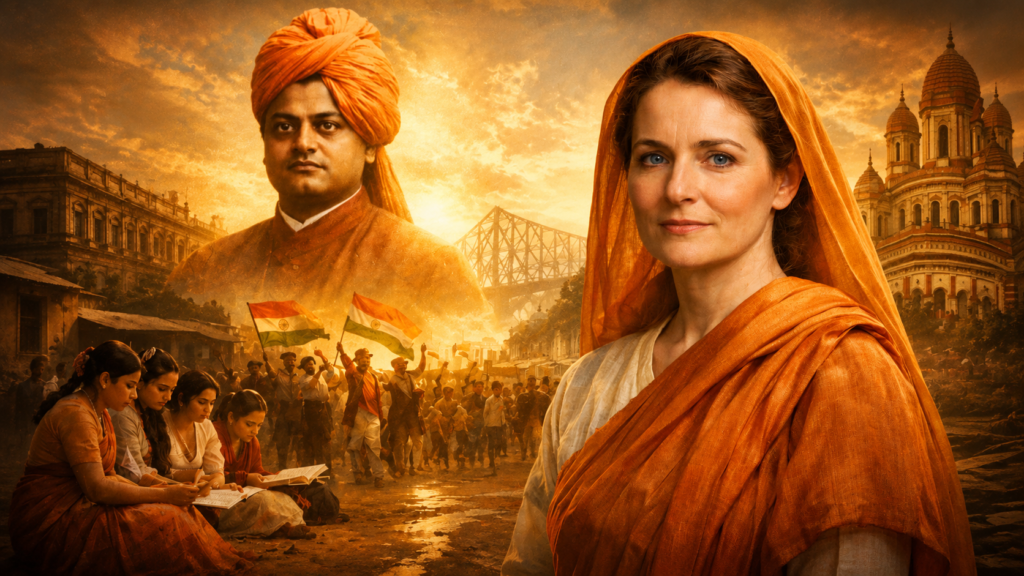
Sister Nivedita – A Life Dedicated to India
1. Margaret Noble before becoming Sister Nivedita
1.1 Birth and background
- Born on 28 October 1867 in Dungannon, County Tyrone (Ireland)
- Came from Irish–Celtic heritage
- Educated at Halifax College
1.2 Education and profession
- Worked as a teacher in girls’ schools
- Opened her own school in Wimbledon in 1892
- Follower of the New Education Movement
- Deeply influenced by the educational ideas of Pestalozzi and Froëbel
1.3 Inner spiritual struggle
- In spite of professional success, she felt
- Religious uncertainty
- Spiritual dissatisfaction
- European life could not answer her deep spiritual questions
2. Meeting Swami Vivekananda – A turning point
2.1 First meeting
- Met Swami Vivekananda in London in November 1895
- His Vedantic teachings
- Awakened her religious spirit
- Gave her a new life purpose
2.2 Vivekananda’s warnings
Before allowing her to join his mission, Vivekananda warned her about:
- Widespread poverty and superstition
- Caste system and social isolation
- Being viewed with suspicion by both Indians and Europeans
- Extreme heat of India
- Lack of European comforts
2.3 Vivekananda’s decision
In his letter of 29 July 1897, he wrote:
- India did not need a man but a “lioness”
- He believed Margaret possessed
- Education
- Purity
- Sincerity
- Love
- Determination
- Celtic strength
2.4 Journey to India and new identity
- Arrived in Calcutta on 28 January 1898
- Took Brahmacharya vows on 25 March 1898
- Received the name Nivedita, meaning “the dedicated one”
3. Work in India – Education and Nation-building
3.1 Women’s education
- Opened a girls’ school at Bagh Bazar on 13 November
- Inaugurated by Sarada Devi
- Initially failed due to social resistance
- Travelled to Europe and America to collect funds
- Restarted the school with Christine Greenstidel
- Grew from a Kindergarten into a High School
- Also educated elderly women
3.2 National awakening
Nivedita believed:
- A nation under foreign rule cannot regenerate
Her main ideas were:
- Faith in one’s inner strength
- Building all-round power
- Drawing inspiration from Sri Ramakrishna and Swami Vivekananda
- From 1902 to 1904, she travelled across India giving lectures
- The Partition of Bengal (1905) made her strongly nationalist
4. How India remembered her
- Rash Behari Ghosh: She gave life and inspiration to young Indians
- Surendranath Banerjee: Her soul was completely Indian
- G. K. Gokhale: Praised her intellect and deep love for India
- Rabindranath Tagore: Called her a true “Mother of the People”
5. Tireless service until death
- Swami Vivekananda died on 4 July 1902
- Nivedita said: “He is not dead. I only want to work.”
- Fell seriously ill in 1905–1906
- Suffered from malaria
- Died in Darjeeling before the age of 44
6. Her writings and ideas
- Studied Indian religion, philosophy, history, and mythology
- Important books:
- Kali the Mother
- The Master As I Saw Him
- Her writings helped:
- Indians understand their own culture
- Westerners understand India’s spiritual depth
Infographics

7. Final meaning of her life
- From Margaret Noble to Sister Nivedita
- A complete surrender to India’s soul and future
- She became Vivekananda’s “lioness”
- Not just a supporter of India, but one with India