
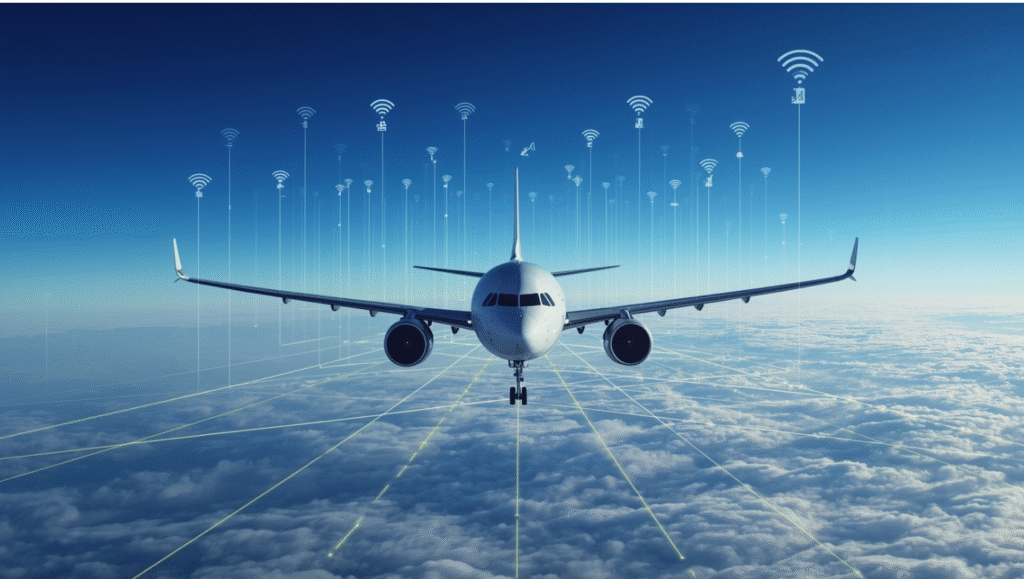
In-flight Internet
Subject: Science & Technology (UPSC Prelims)
Source: The Hindu
Context
As air travel increases worldwide, most airlines now provide Wi-Fi onboard. This has led to curiosity about how planes stay connected to the Internet while flying at high altitudes, far from mobile towers.
What is In-flight Internet?
In-flight Internet is the Wi-Fi service provided inside an aircraft, allowing passengers to browse, message, and stream while flying. The aircraft connects to the Internet using special communication equipment that links either to satellites or ground-based towers.
How In-flight Internet Works (Simple Steps)
- Passengers connect their devices to the plane’s Wi-Fi network.
- Wi-Fi inside the aircraft is distributed through multiple access points in the cabin.
- Data is sent to and from the ground using:
- Ground Towers (ATG – Air-to-Ground systems) OR
- Satellites (GEO / LEO)
- The aircraft antenna keeps a constant link with either a tower or satellite.
- The signal finally reaches ground Internet networks and connects you online.
Types of In-flight Internet
| Type | How it Works | Where It Works Best |
|---|---|---|
| Air-to-Ground (ATG) | Connects to mobile-like towers on land | Good over land, not oceans |
| Satellite-based | Connects via GEO / LEO satellites in space | Works globally including oceans |
Key Features
- Internet availability even at 30,000–40,000 feet.
- GEO satellites offer large coverage; LEO satellites offer faster speed and low delay.
- Smart bandwidth control—streaming may be restricted to avoid overload.
- Multiple access points ensure Wi-Fi across the entire aircraft cabin.
Limitations
- Limited bandwidth → slower speeds if many users are online.
- GEO satellite signals travel long distances → more delay in response.
- Weather, congestion, and routing can affect quality.
- Costly for airlines due to expensive equipment and satellite bandwidth.
Summary:
In-flight Internet is enabled by either ground towers or satellites. While it provides seamless connectivity mid-air, bandwidth limits, signal delays, and high operational costs remain key challenges.