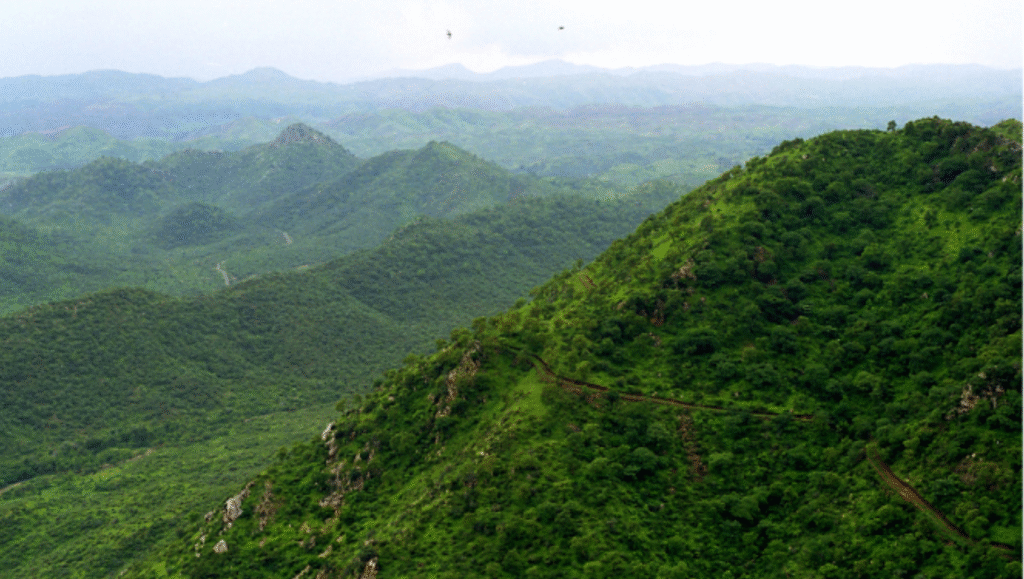
Aravalli Range: Geological Legacy, Ecological Significance
Syllabus: Indian Geography (UPSC Prelims)
Basic Facts
- One of the oldest fold mountain ranges in the world, dating back over 2.5 billion years (Proterozoic).
- Extends about 700–800 km from Delhi–Haryana through Rajasthan to Gujarat.
- Forms part of the Aravalli–Delhi Orogenic Belt and the Indian Shield.
- Highest peak: Guru Shikhar1 (1,722 m), Mount Abu region, Rajasthan.
Geography & Ecology
- Acts as a barrier preventing desertification, slowing the eastward spread of the Thar Desert.
- Recognised as an eco-sensitive zone with rich biodiversity, including habitats for leopards, hyenas, jackals, caracal, and the Indian wolf.
- Hosts protected areas like Sariska Tiger Reserve, Mount Abu Wildlife Sanctuary, and Asola Bhatti Wildlife Sanctuary.
- Important wildlife corridors:
- Northern Aravalli Leopard Corridor (Delhi–Haryana belt)
- Southern Aravalli Leopard Corridor
- Great Green Wall of India concept zone
Hydrology
- Important watershed for northwestern India.
- Gives rise to the Banas, Sahibi, and Luni rivers.
- Supports water recharge for Delhi, Haryana, Rajasthan, and Gujarat.
Mineral Resources
- Rich in marble, granite, mica, and metallic ores such as copper, zinc, and lead.
Biodiversity Highlights
- Diverse vegetation from dry deciduous to scrub forests.
- WII surveys record species like leopards, golden jackals, nilgai, civets, porcupines, and peafowl.
- Increasing need for wildlife corridor protection due to habitat fragmentation.
Historical & Cultural Significance
- Contains ancient forts, settlements, and archaeological sites.
- Historically influenced regional settlement patterns, trade routes, and defence structures.
Environmental Challenges
- Deforestation, overgrazing, and illegal mining causing habitat degradation.
- Groundwater depletion and soil erosion increasing due to unregulated extraction.
- Urbanisation pressure around Delhi–NCR and parts of Rajasthan and Haryana.
- Pollution affecting water bodies and forest patches.
Judicial & Institutional Role
- Supreme Court and NGT have issued major directives restricting mining and construction in Aravalli.
- MoEF&CC notified several protected zones for conservation.
- Central Empowered Committee (CEC) monitors violations.
- Conservation efforts include afforestation, wildlife corridor protection, and illegal construction removal.
- Question Reference
(HPAS PYQ 2025) ↩︎