
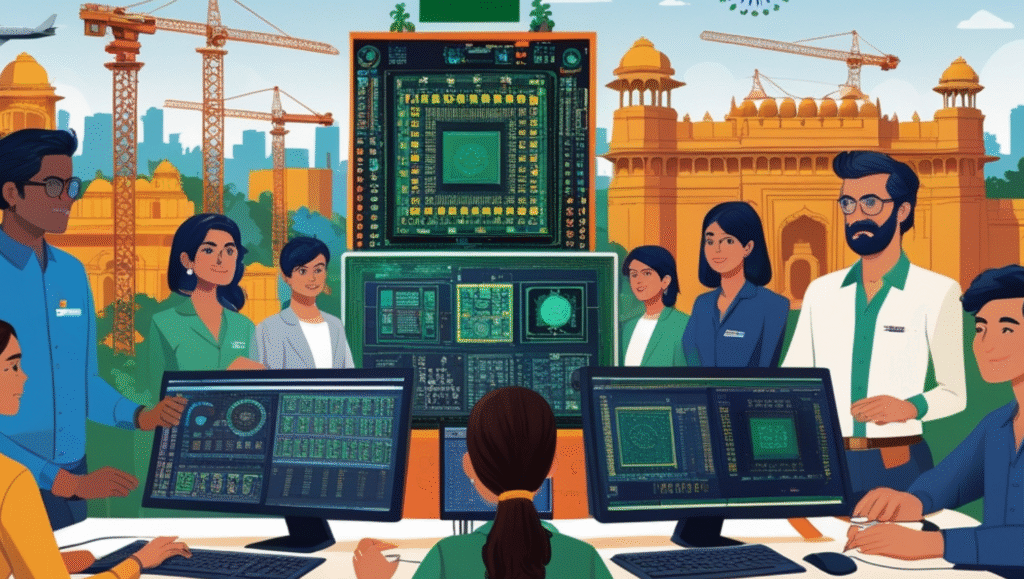
Semiconductor Designers Power India’s Chip Dreams
Syllabus: Science & Technology (UPSC GS III)
Source: TH
Context:
India is fast emerging as a semiconductor design hub, hosting 20% of global chip designers. The government has approved 10 fabrication and assembly projects under the ₹76,000 crore Semicon India Mission, aiming to make India a global player in chip production.
Current Status
- Design Powerhouse: India has ~1.25 lakh semiconductor design engineers, producing 3,000 chips annually.
- Policy Push: Semicon India Programme offers 50% capital support, with states adding 20–25%.
- Manufacturing Progress: Micron’s ₹22,500 crore ATP facility in Gujarat is under construction, expected by 2024.
- R&D Initiatives: Chips to Startup (C2S) program will train 85,000 engineers in five years.
- Global Context: Semiconductor consumption in India is projected to reach $110 billion by 2030 (~10% of global share).
Drivers of Semiconductor Design & Manufacturing
- Geopolitical Realignment: “China+1” strategy encourages firms to shift capacity to India.
- Market Size: India is the world’s fastest-growing consumer electronics market and second-largest smartphone producer.
- Policy Incentives: PLI, DLI, SPECS schemes reduce cost disadvantages.
- Skilled Talent: 8+ lakh engineers graduate annually; access to EDA tools has boosted design capabilities.
- R&D & Academia Linkages: IITs, IISc, IIITs collaborate with global firms like Synopsys and Cadence.
Economic & Strategic Impacts
- High-Value Jobs: Semiconductor jobs have a multiplier of 6.7, creating ecosystem employment.
- Export Growth: Electronics exports projected to quintuple by 2026, aiding trade balance.
- Strategic Security: Domestic chip capacity reduces reliance on imports, crucial for defence and telecom.
- Innovation Push: IP creation and patents strengthen India’s global technology footprint.
- Regional Development: New semiconductor hubs in Gujarat, Karnataka, and Odisha promote decentralized growth.
Key Initiatives
- Semicon India Programme (₹76,000 Cr): Capital support for fabs, OSAT/ATMP, and display facilities.
- Design Linked Incentive (DLI) Scheme: Covers up to 50% of R&D costs for fabless startups.
- Chips to Startup (C2S): Trains 85,000 engineers, provides EDA tools to 100+ institutions.
- PLI Scheme for IT Hardware & Electronics: Boosts domestic production of smartphones, laptops, and servers.
Challenges
- Capital Intensity: Fab setup costs $10–15 billion; requires sustained support.
- Talent Gap: Only a fraction of graduates are industry-ready.
- Infrastructure Deficit: Stable power, ultra-pure water, and logistics are prerequisites.
- Venture Capital Constraints: Long gestation periods deter investors.
- Policy Predictability: Sudden changes in tariffs or licensing may discourage foreign investment.
Way Forward
- Focus on Legacy Nodes: Target 28 nm+ chips for auto, IoT, and energy sectors.
- Strengthen R&D Funding: Raise national R&D spend from 0.7% to 1.5% of GDP.
- Risk-Sharing Models: Encourage PPP models where government de-risks early capital expenditure.
- Cluster Development: Build semiconductor ecosystems near universities and industrial corridors.
- Global Partnerships: Expand India-US MoU, collaborate with Japan, Taiwan, and EU for technology transfer.
Conclusion
Semiconductors are the commanding heights of the digital economy. India’s design talent, large market, and policy push create a historic opportunity. Success will depend on execution, stable policies, and a strong ecosystem, enabling India to move beyond assembly to become a product nation and global innovation driver.