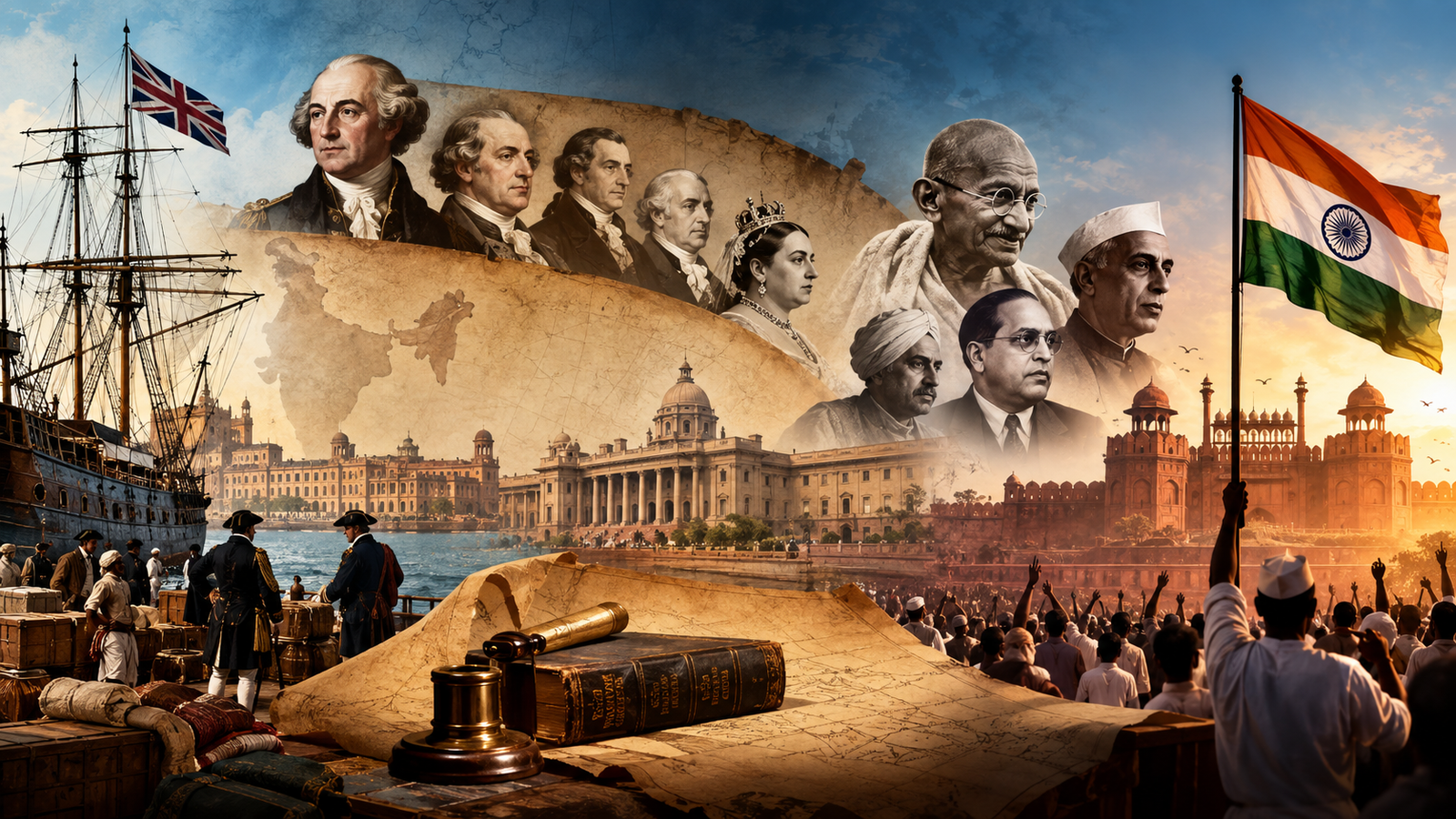

Battle of Buxar and Its Historical Significance (1764)
Syllabus Tag: GS Paper 1 (Modern Indian History), GS Paper 2 (Polity – Constitutional Development)
Background to the Battle of Buxar
- The British East India Company initially installed Mir Kasim as the Nawab of Bengal, expecting him to act as a puppet ruler. However, Mir Kasim proved assertive and independent.
- Key Issues Leading to Conflict:
- Revenue Dispute: Mir Kasim demanded accountability from Ram Narayan, the Deputy Governor of Bihar, but English officials in Patna supported Ram Narayan.
- Misuse of Dastaks (Trade Permits): Company servants misused dastaks (duty-free trade passes), harming local revenue and traders.
- Trade Malpractices: British officials forced Indian traders to sell goods at low prices, violated trade ethics, and sold dastaks for commission.
- Abolition of Duties: In retaliation, Mir Kasim abolished all transit duties, provoking conflict with the British.
The Battle of Buxar (October 22, 1764)
- Fought between the British East India Company and the combined forces of:
- Mir Kasim (Nawab of Bengal),
- Shuja-ud-Daula (Nawab of Awadh),
- Shah Alam II (Mughal Emperor).
- Result:
- The English, under Major Hector Munro, decisively defeated the allied Indian forces.
- Preceding victories at Katwah, Murshidabad, Giria, Sooty, and Munger further ensured British dominance.
Significance of the Battle
- The battle marked the defeat of both the Nawab of Bengal and the Mughal Emperor.
- It established the British as the dominant political power in northern India, shifting power irreversibly in their favor.
Post-Battle Developments
Reappointment of Mir Jafar:
- Mir Jafar was reinstated as Nawab (1763), ceding Midnapore, Burdwan, and Chittagong to the Company.
- The British gained duty-free trade privileges, except a 2% duty on salt.
- After Mir Jafar’s death, Najim-ud-Daula, his minor son, was made Nawab, but real power remained with the British.
Treaty of Allahabad (1765)
Negotiated by Robert Clive, this treaty formalized British control:
Treaty with Nawab Shuja-ud-Daula:
- Surrender of Allahabad and Kara to Shah Alam II.
- Payment of Rs 50 lakh as war indemnity to the Company.
- Recognition of Balwant Singh’s estate in Banaras.
Treaty with Shah Alam II:
- Shah Alam II would reside in Allahabad under British protection.
- He granted the Diwani (revenue rights) of Bengal, Bihar, and Orissa to the Company in exchange for Rs 26 lakh annually.
- Paid Rs 53 lakh for Nizamat functions (defence, policing, and justice).
Clive’s Strategic Approach:
- Avoided annexing Awadh to maintain a buffer state.
- Used the Mughal emperor as a figurehead, thereby legitimizing the Company’s rule.
Dual System of Government in Bengal (1765–1772)
Introduction by Robert Clive:
- Dual administration was introduced where:
- Company held Diwani rights (revenue collection).
- Nawab retained Nizamat rights (law and order).
- In practice, the Company appointed its own officials:
- Mohammad Reza Khan (Deputy Diwan and Deputy Nazim in Bengal),
- Raja Shitab Roy (Deputy Diwan in Bihar).
Advantages to the Company:
- Allowed the Company to rule without responsibility.
- The Nawab remained a nominal ruler, dependent on Company funds and military.
Failure of the Dual Government
Impact on Trade:
- Abuse of dastaks destroyed Indian merchants’ competitiveness.
- Indian industries, especially cotton and silk, collapsed.
- Company officials set exploitative prices, punishing dissenting artisans.
Impact on Agriculture:
- Zamindari system abused: Land revenue auctions caused farmers’ exploitation.
- Annual increases in revenue demands led to rural distress.
- Resulted in widespread banditry and famines (e.g., 1767–69).
Impact on Administration:
- 30 districts created with English supervisors, whose primary goal was revenue maximization, not governance or welfare.
- Supervisors pursued private business interests, leading to administrative failure.
Abolition of the Dual Government (1772)
- Warren Hastings, as Governor of Bengal, was directed to abolish dual rule.
Major Reforms:
- Hastings dismissed deputy Diwans (Reza Khan and Shitab Roy) and took over Diwani functions.
- He assumed responsibility for civil justice, removing Nawab’s authority.
- The Nizamat powers were withdrawn, and the Nawab was given a pension of Rs 16 lakh.
Conclusion
The Battle of Buxar was a decisive moment in India’s colonial history. It not only consolidated British dominance in eastern India but also paved the way for formal administrative and constitutional changes. The Treaty of Allahabad, the dual government experiment, and its failure directly shaped British governance in India, ultimately influencing the framework of modern Indian polity.